Showing posts with label is youth football safe. Show all posts

Tuesday, October 08, 2013

Reasons why the NFL's new concussion rules aren't working

This article details issues with the NFL's new concussion rules and determines that the issues in football safety lie inherently within the sport.

In January, the NFL announced that, starting with the 2013 season, all games would be played with an independent neurologist on the sidelines to assist with the evaluation and treatment of head injuries. It looked like the league had done a good thing. It was establishing a new, unbiased procedure to promote player safety—an effort made all the better by the fact that it didn't involve placing the burden on the players themselves.

But the fundamental problem with football safety is football, and the league's new program is proving it.

Let's start with some background on the new rule. The players union had long demanded that the league require the presence of independent neurotrauma specialists who could evaluate players without interference or influence from any teams. To wit: On the same day the NFL made its announcement, the NFLPA cited a poll indicating that 78 percent of players didn't trust their own teams' medical staffs.

The league's decision to require these unaffiliated consultants was announced at a news conference held just before the NFLPA's annual Super Bowl week news conference. Also on that same day, NFLPA executive director DeMaurice Smith said the union had not been notified of the league's plan to make the change. And all this was at a time when the NFL was still preparing for a court battle against the concussion-related lawsuits involving thousands of former players who accused it of distorting information about the long-term effects of head trauma. Those suits have since been settled.

The two sides eventually smoothed over their differences, and soon the NFLPA was on board with the plan to have independent neurologists on the sidelines. An NFLPA spokesman told me the league and the union have since worked out an agreement by which they both have input in selecting those independent sideline consultants. Those consultants are picked from a list of experts in all 31 NFL cities. The consultants must not be affiliated with any NFL teams. TheNFL's concussion protocol also spells out that the each consultant must be "board certified or board eligible in neurology, neurological surgery, emergency medicine, physical medicine and rehabilitation or any primary care CAQ sports medicine certified physician and [have] documented competence and experience in the treatment of acute head injuries." Since last year, the protocol also mandates that an athletic trainer must be present up in the booth serve as a "spotter" for both teams by reviewing video and replay technology.

So what could go wrong? Why would there be any problems with diagnosing and handling concussions? Let's look at three situations involving three players in three games. Each one illustrates what the NFLPA spokesman told me was an "area of concern" for the players association after the first month of the new season.

The scenario: In Week 1, Jeremy Kerley of the Jets was concussed when he caught a pass over the middle toward the end of the first half against the Bucs. Kerley was hit by three different players, and Tampa's Mark Barron was flagged for unnecessary roughness:

Kerley was taken to the locker room and given the concussion tests, but he later returned to the game. The following day, he was held out of practice when he was evaluated again and diagnosed with concussion symptoms. The Jets had a short week heading into their next game, and Kerley missed their Week 2 game against the Patriots before returning to play in Week 3 against the Bills. 

The problem: Players don't always show concussion symptoms immediately.

The scenario: In Week 3, the Raiders' Terrelle Pryor took a helmet-to-helmet hit from the Broncos' Wesley Woodyard. Pryor had tucked the ball and made himself a runner, and the hit occurred inside the tackle box, so Woodyard was not penalized:Pryor lay on the turf momentarily but played two more snaps. After the Raiders turned the ball over on downs, he started showing symptoms during a sideline evaluation and was removed from the game. The next day, Pryor tweeted, "I don't remember much!" He returned to practice in a limited role later in the week and was ultimately held out of Sunday's game against the Redskins. The league's concussion protocol says that "if the occurrence of a concussion is unclear, or a player sustains a mechanism of injury ('big hit') that is reasonably expected to give rise to a concussion... the player shall be removed immediately from the field by Club medical personnel." The hit Pryor took certainly seems to fit that definition, and the NFLPA isinvestigating the Raiders' handling of Pryor to determine why he remained in the game. Per Mike Florio, the NFLPA does not want the typical sideline chaos to be used as an excuse for any failure to be properly vigilant in following the mandated protocols. The union spokesman told me that, depending on the outcome of its investigation, the NFLPA could consider filing a grievance.

The problem: A possible breakdown in protocol.

The scenario: In Week 2, Steelers running back Isaac Redman was injured on the opening kickoff after taking a helmet-to-helmet hit from the Bengals' Jayson DiManche. Redman was blocking on the play, and the collision happened away from the ball. Here, you can see Redman go down around the 30-yard line just as the action stops:

The problem: The tendency of players to not want to come out of the game.

These aren't rare, exotic scenarios. They're all things that come up normally in the course of play, like two-point conversions and onside kicks, and that's the issue. The new program is designed to keep concussed players from playing, yet that's not what's happening. These are problems that can't be solved via fiat and bureaucracy, and there's a simple inference to be drawn from that fact: you can't really fix football without turning it into another sport.

Read more, and see the videos referenced here

Sunday, September 01, 2013

Concussion myths

This article discusses myths parents believe on concussions in football, and tells what the truth is.

What are some things to clear up before kids hit the fields this fall?
One myth is that if an athlete hasn't blacked out or lost consciousness, they haven't suffered a concussion.
In only about 10 percent of concussion cases does the person lose consciousness. Just because a young athlete doesn't black out does not mean that their brain has not been injured. Symptoms may include headaches, a sensation of pressure in the head, dizziness, nausea as well as mood changes, sleep disruption or loss of memory. In the article on our ParentMap website, we have more information on symptoms.
People often believe that if a child suffers a concussion, adults will know immediately.
In fact, symptoms can take minutes, hours, even a couple of days to develop. This is why it is so critical for an athlete to be benched until they can be evaluated by a certified trainer or medical professional.
Most tragedies due to concussions are preventable as long as the athlete is not exposed to further head trauma.  After a bad first hit, a second hit, even if smaller in force, can have catastrophic results such as second-impact syndrome.
Sanctioned football practices started last week, and that's what we always focus on, but are football players the only ones who need to know about the signs of concussions?
No, that's another thing to dispel. While football has the highest rate of concussion, lacrosse and hockey have high numbers -- and so do girls' soccer, lacrosse and basketball. It's not just a boy thing.
In fact, in sports where the rules of contact are the same for girls and boys, such as soccer and basketball, girls have higher rates of concussion. There are differing theories for why this is, but no definitive research to explain it.
We hear about companies making safer helmets. Do they make a difference?
No. As the University of Washington/Harborview Medical Center doctors in the Seattle Sports Concussion program will tell you over and over again, there is no such thing as a helmet that prevents concussions. Helmets can prevent skull fractures, but compare a mild traumatic brain injury to shaking Jello inside a Tupperware container. Nothing on the outside of the skull can prevent the brain inside from slamming into the hard bones of the skull.
If an adult isn't sure if a child has suffered a concussion, is it better to be safe than sorry and have them sit out?
Yes. In fact, with the Lystedt Law that's been in effect four years now, coaches who even suspect a child has suffered a concussion must pull the athlete until they get properly evaluated by a medical professional. And they have to get medical approval before returning to play. That too is key, because if their brain has not healed and they get hit again, that can be catastrophic.
Before they return to play, are they fine to go about as long as they're not doing the sport?
No, mental rest is actually very important to recovery. Doctors treating concussions will say no TV, video games, test-taking or studying because that can slow the brain's healing.
Read more here

Thursday, August 22, 2013

Concussions Occur In Youth Football Primarily During Practice, Not Games

A study claims that the majority of concussions in youth football happen during practices rather than during games.

Less contact during practice could mean a lot less exposure to head injuries for young football players, according to researchers at Wake Forest Baptist Medical Center and Virginia Tech.
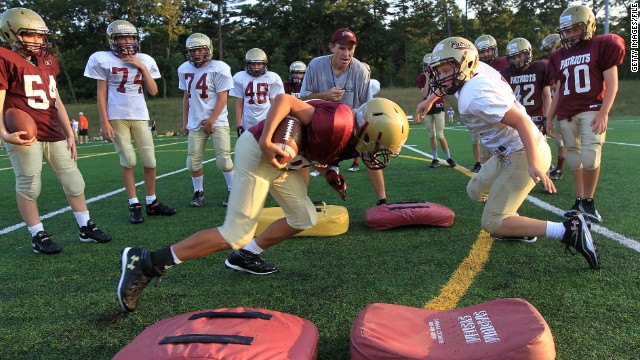
Their study of 50 youth-league players ages 9 to 12 -- the largest ever conducted to measure the effects of head impacts in youth football -- found that contact in practice, not games, was the most significant variable when the number and force of head hits incurred over the course of a season were measured. Numerous studies in this area have been done on high school and college players, but those findings do not necessarily apply to younger players.
Though more than 70 percent of the football players in the United States are under age 14, there is no clear, scientifically based understanding of the effect of repeated blows to the head in young players, said Steven Rowson, Ph.D., assistant professor at the Virginia Tech-Wake Forest University School of Biomedical Engineering and lead author of the study, which is published in the current online edition of the Annals of Biomedical Engineering.
To quantify youth football players' exposure to head impacts in practices and games over the course of a single season, the researchers employed sensors in the helmets of 50 players on three teams in two different leagues.
The sensors were installed on an elastic base inside the helmet so that they remained in contact with the head throughout the duration of head impact, allowing for measurement of head acceleration rather than that of the helmet. Data from the sensors were transmitted wirelessly to a computer on the sideline and processed to measure both the linear and rotational head acceleration caused by each impact. All data were analyzed on an individual player basis and then averaged to represent the exposure level of a typical 9- to12-year-old football player.
The most important finding was that substantial differences existed among the three teams for both frequency and intensity of the impacts, Rowson said. For the entire season, players on team A experienced an average of 37 to 46 percent fewer impacts than players on teams B and C. For example, the average player on team A experienced 158 impacts during the season, compared to 294 and 251 on the other two teams. This can be attributed to several factors, but the primary reason was that team A had fewer practices during the season than teams B and C, the study showed. During games, impact frequency and acceleration magnitudes were not significantly different among the teams.
In addition, team A competed in a league that had implemented Pop Warner rule changes, including a limit on contact during practice sessions. Teams B and C had no such restrictions.
Although the practice contacts were limited, there were no differences in the head acceleration magnitudes measured in the games between all three teams. The 95 percent head accelerations ranged from 41 g to 45 g for all three teams and were not significantly different. These data show that limiting contact in practices does not create an adverse effect in games.
"It is striking that you can cut head impacts for a player in half just by modifying practice, and it does not seem to change the game," said Alexander Powers, M.D., assistant professor of neurosurgery at Wake Forest Baptist and co-author of the study. "This may be very important in kids where brains are developing."
Coaching style also had a major influence on factors such as the types of drills used in practice and the plays called in games, which would likely contribute to the differences in the head impact exposure that players experienced, the authors reported. "We hope that the findings will help improve the safety of youth football through rule changes to limit contact in practices, coach training and equipment design, especially in developing youth-specific helmets to better reduce accelerations from head impacts," Rowson said.
Funding for the study was provided by the Childress Institute for Pediatric Trauma, the National Highway Traffic Safety Administration and the Virginia Tech-Wake Forest University School of Biomedical Engineering and Sciences.
Read more here

Tuesday, July 30, 2013

Concussion protection from helmets: There is no safest football helmet

Regardless of how new or old and expensive or inexpensive a helmet is, they all provide the same level of protection from concussions.

Given the recent controversies over concussions in the NFL, you're probably a little leery about letting your kid play football. We can't blame you. Even future Hall of Famer Kurt Warner told the "Dan Patrick Show" last year that he'd be scared for his sons' safety if they followed their gridiron dreams.

Concussions are a problem for football players, from the pro ranks right on down to pony leaguers. Teenage boys suffer the most sports-related traumatic brain injuries – including concussions – each year, most of which stem from playing football or crashing bicycles. No question: There's risk involved in sending your son out to get pummeled at the 50-yard line, so you want him to sport the best helmet available. Just don't get lured into shelling out big bucks or pressuring his school to buy the latest and greatest helmet. According to a new study, safest does not mean newest, flashiest, or most expensive.

Researchers tracked more than 1,300 high school football players throughout the 2012 season and found that all helmets, regardless of brand, model, or whether they were shiny-new or up to 10 years old, offered the same protection from concussions. Which means that when one brand claims its helmets are safer than the competitors' – or that its spendiest model is the best you can get – it's basically an empty ploy for your pocketbook, says lead researcher Timothy McGuine of the University of Wisconsin Health Sports Medicine Center.

According to McGuine, football helmets are tested and strictly regulated by the National Operating Committee on Standards for Athletic Equipment. To make sure they stay in prime working order, all helmets sold to schools must be serviced by the manufacturer every two years and pitched after 10. The result: "Not one NOCSAE-approved helmet is bad," McGuine says. "They're all hard shells with slightly different padding and fixation systems, but to say one is better than another just isn't true."

Given his findings, McGuine says to rest easy when it comes to helmet quality and your kid's concussion risk. Yes, brain injuries are always possible in contact sports, but he's confident football players' heads are as safe as they can be with today's helmets, regardless of whether they cost $250 or $850.


Read more here

Sunday, June 09, 2013

More concussions in youth football happen during games, not practice

A new study shows that in youth football, more concussions occur during games instead of during practice.

Sports-related concussion has been referred to as an "epidemic" by the Centers for Disease Control and Prevention. Emergency department visits for concussions have increased 62% between 2001 and 2009. Despite the lack of data regarding the rates of concussions in youth football (children aged 8-12 years), concerns have been raised about the sport being dangerous for this age group. In a new study scheduled for publication in The Journal of Pediatrics, researchers analyzed the incidence rates of concussion in youth football players in this age group and found a significantly higher incidence during games compared to practice sessions.
Anthony P. Kontos, PhD, and colleagues from the University of Pittsburgh and Cornell University studied 468 participants, 8-12 years of age, from 4 youth tackle football leagues, consisting of 18 teams. Player exposures were recorded for both games and practices. There were 11,338 total player exposures during the study period, with 20 medically-diagnosed concussions involving 20 different participants; 2 concussions occurred during practice and 18 occurred during games. Players aged 11-12 years were almost 3 times more likely to have a concussion than players aged 8-10 years. The majority of concussions involved helmet-to-helmet contact, and 95% involved players in skilled positions (e.g., running back, quarterback, linebacker). The incidence rate during games was approximately 2 times higher than previously reported, whereas the practice rate was comparable or even lower than previous findings. Overall, players were 26 times more likely to suffer a concussion in a game than in practice.
In the US, approximately 3 million youth participate in tackle football. In light of concerns regarding concussions, Pop Warner, the largest organized league with 425,000 participants, recently limited contact practice time to reduce concussions. However, contact practice time is when proper tackling technique can be taught and reinforced in a controlled environment. According to Dr. Kontos, "Limiting contact practice in youth football may not only have little effect on reducing concussions, but may instead actually increase the incidence of concussions in games via reduced time learning proper tackling in practice." A better approach to reducing concussions in youth football may be to focus on awareness and education among youth football administrators, coaches, parents, and players.
Read more here

Wednesday, August 29, 2012

New Concussion Warning Label Is Not A Big Score For NFL Players Suing Helmet Manufacturer Riddell


New Concussion Warning Label Is Not A Big Score For NFL Players Suing Helmet Manufacturer Riddell

Some retired NFL players are suing helmet company Riddell for their helmets not protecting against concussions and, more importantly, for not warning about the long-term risks of concussions on the helmet itself. A new warning label on Riddell's helmets is not as big of a change as these NFL players hoped.

Riddell, the official helmet manufacturer of the NFL, is being sued by many retired football players for failing to effectively protect them against the long-term risk of concussions and lying about the company’s ability to reduce the risk of head trauma. Since being named as a defendant, Riddell appears to have taken measures to provide better information to consumers, including attaching stickers on products that contain a warning label (as displayed to the right).
The first statement on the warning label is in bold and all-caps and reads, “NO HELMET CAN PREVENT SERIOUS HEAD OR NECK INJURIES A PLAYER MIGHT RECEIVE WHILE PARTICIPATING IN FOOTBALL.” While many would think that the use of this label is a sort of admission that these types of concussion warning labels should have been in use in the past (and indicating that Riddell should be held liable for damages), getting the label admitted into evidence is complicated and may not be an easy score for the retired football player Plaintiffs.
On July 17, 2012, the Plaintiffs filed their Amended Master Administrative Long-Form Complaint in the United States District Court – Eastern District of Pennsylvania, where the Judicial Panel on Multi District Litigation decided to consolidate and transfer the many individual concussion-based claims. U.S. District Courts adhere to federal rules. Rule 407 of the Federal Rules of Evidence is titled, “ Subsequent Remedial Measures” and states,

“When measures are taken that would have made an earlier injury or harm less likely to occur, evidence of the subsequent measures is not admissible to prove:

  • negligence;
  • culpable conduct;
  • a defect in a product or its design; or
  • a need for a warning or instruction.
But the court may admit this evidence for another purpose, such as impeachment or–if disputed–proving ownership, control, or the feasibility of precautionary measures.”
The Plaintiffs have alleged that the Riddell Defendants inaccurately marketed their Revolution helmet as being safer in reducing the risk of concussions by 31% and that the Riddell Defendants failed to warn any Plaintiff or retired player of the long-term health effects of concussions. It is unlikely that the Plaintiffs would be able to introduce the new concussion warning label into evidence to prove either of those 2 claims. Further, the Plaintiffs have included counts for 1) Strict Liability for Design Defect, and 2) Strict Liability for Manufacturing Defect, and based upon the exclusions in Rule 407, above, Plaintiffs would similarly be barred from introducing the warning label.
Perhaps the only way that the Plaintiffs are able to include the concussion warning label on their Exhibit List is to argue that it should be admitted to prove the feasibility of precautionary measures. This is typically a tricky area for courts dealing with manufacturer liability. If the court were to allow the concussion warning label into evidence to prove the feasibility of precautionary measures, the judge must instruct the jury that it is only on the issue of feasibility that they should consider the Riddell Defendants’ new warning on their helmets, and must do everything possible to prevent the Plaintiffs from using the label to prove negligence (which the Plaintiffs include as a count against the Riddell Defendants) or any of the other non-admissible bullet points as stated in the Rule. The problem with the introduction of the label for the limited purpose of determining feasibility of precautionary matters is that it opens the door to abuse by the Plaintiffs to prove other claims (such as negligence and design defect), which technically constitutes reversible error should the Riddell Defendants choose to appeal an unfavorable verdict. Based on that alone, my thought is that the new concussion warning label, if added to the Plaintiffs’ Exhibit List, will be stricken by the Court and not introduced to a jury.
Read more here

Sunday, July 29, 2012

Recognizing symptoms of concussions is necessary for coaches and parents


USA Football discusses the importance of parents and coaches knowing and recognizing concussions.

The Giants teamed up with USA Football on the Protection Tour on Tuesday at MetLife Stadium for a program designed to educate parents, players and coaches about signs and symptoms of concussions, and the importance of proper equipment and tackling techniques.
"I wanted to come and learn as much as I could," said Angelo Pira, a parent from Westwood who brought his son Dominic, 8, to the event. "My wife and I are worried about concussions. Some of the things I learned were shocking."
During a 25-minute seminar conducted by Dr. Pat Kersey, USA Football’s medical director, he described a concussion as similar to when a yolk shakes within an egg shell, the yolk being the brain and the shell being the skull.
Kersey then outlined a series of indicators parents and coaches should be looking for when it comes to concussions. Headaches, nausea, memory problems and blurry vision all are common signs, but the biggest sign is if the kids are not feeling like themselves.
"A lot of the signs of concussions are not visible," Kersey said. "So I think parents should really trust their instinct if they notice their child is not acting like themselves.
"Physically they can be fine, they can move arms and legs and can jump and run, but if they’re emotionally different or their personality changes, they should be checked out. That’s why it’s important to educate parents."
Kersey’s words hit home for Pira when he recalled that Dominic came home from wrestling practice a few years ago, and was not acting like himself.
"It made me think back that maybe he had a concussion," said Pira, who volunteers as a Westwoodfootball youth coach.
The statistics for concussion rates in youth sports are alarming. It’s estimated that anywhere from 1.6 million to 3.8 million kids suffer concussions every year. Once athletes suffers a concussion, they become three to six times more likely to suffer another.
In 2011, the National Federation of State High School Associations reported that 15 percent of all sports-related injuries are concussions. Sports and recreational activities contribute to about 21 percent of all traumatic brain injuries among American children.
"The numbers are quite staggering, and that’s the number of reported cases," said David Egazarian ofOradell, who brought his son Steven, 7, to the event. "Think of all the unreported cases. It’s important to be aware of all the information about concussions."
And it’s not just limited to football. Soccer, basketball, baseball, lacrosse and cheerleading also have high rates of concussions. Soccer has the highest rate worldwide and football is the highest in the U.S.
And it’s not just sports. Kids can suffer concussions anywhere from falling off their bikes to falling out of bed.
"The thing I learned was that I thought you got a concussion [only] when you blacked out, but that’s not the case," said Kim Mehandzic of Westwood, who brought her son Nik, 8, to the event.
"I think it’s important to know that concussions do heal if they’re treated properly. So I would let my son keep playing sports. They learn valuable life lessons through team sports. Parents have to trust their instincts."
Read more here

Friday, June 29, 2012

Preventing concussions is goal of youth athletics


How to prevent concussions and the damage they do to athletes is the hottest and most controversial topic on today’s youth sports scene, especially in football.

New videos are constantly being released showing the danger of hard hits, coaches are required to take classes on recognizing concussions, some states go so far as to require coaches to take tests and medical advisory boards have been formed to weigh in on concussions.

Central in all of this is that concussions can be limited by teaching proper tackling techniques.

Most coaches teach players to be aggressive tacklers, who in front-on tackling, should step into the opponent and hit with their shoulder pads — not their helmets. Tacklers should keep their feet moving to continue their momentum, and wrap both arms around a ball carrier while grabbing his jersey. The emphasis for most coaches is that first contact should never be made with the helmet.

Which brings us to headgear.

While, there is no such a thing as an anti-concussion helmet, there are new high-technology headgear and face masks that offer maximum protection.

In Payson, the value of helmets that provide protection against high-impact collisions is being recognized.

This summer, Northern Arizona Youth Football League officials pooled their resources to purchase 100 new state-of-the-art Riddell helmets. In all, the tab exceeded $7,000, which NAYFL official Pamela Way says was money well spent.

Last football season, then-PHS head coach Byron Quinlan purchased new helmets for his players and also donated $4,000 of club football money to Rim Country Middle School to buy new Riddell helmets for Maverick players.

Although Quinlan wore a different brand of helmet when he played at PHS in the early 1990s, he favored Riddell as a coach.

But every high school coach has his favorite brand, which he believes offers his players maximum safety and protection Coaches will argue long and hard about which brand is the better helmet.

In addition to Riddell being a major producer of helmets, Schutt, Adams and Xenith are also at the forefront.

Helmets evolved from simple leather padding to combinations of metal and plastic designed to prevent catastrophic head injuries.

Today, most helmets are made of stiff polycarbonate shells lined with dense foam padding. Some have pneumatic padding and others have an inflating system.

The Xenith XI helmet recently dropped its in-helmet foam in favor of the air-filled shock absorbers similar to air bags in cars.

At Virginia Tech researchers have been studying different types of helmets and recently released the results of a new rating system of adult football helmets.

Only one helmet received the coveted five-star rating, but four earned the four-star very good ranking.

The data marks one of the first times researchers have provided the public with comparative test results. The data compiled by Virginia Tech showed the best helmet currently available to the public is the Riddell Revolution Speed, which earned the five-star rating.

Schutt ION 4D, Schutt DNA Pro+, Riddell Revolution, Xenith X1 and Riddell Revolution IQ received four-star ratings.

The helmets range in price from $170 to close to $300. While that makes some cost prohibitive to public schools and youth leagues, coaches continue to shop for the best helmets at the best value.

While manufacturers have been working nonstop to make the safest helmets possible, the best tools for minimizing the risk of head injuries remain teaching proper tackling techniques and improved concussion education.

Symptoms of a concussion

There are some common physical, mental and emotional symptoms a person may display following a concussion. Any of these could be a sign of traumatic brain injury:

• confusion or feeling dazed

• clumsiness

• slurred speech

• nausea or vomiting

• headache

• balance problems or dizziness

• blurred vision

• sensitivity to light

• sensitivity to noise

• sluggishness

• ringing in ears

• behavior or personality changes

• concentration difficulties

• memory loss

Read more here

Sunday, June 17, 2012

Amidst Concern About Head Injuries, Youth Football League Issues New Practice Rules

I am happy to see changes to football practice policies based on data of childhood head impacts. JR


Amidst Concern About Head Injuries, Youth Football League Issues New Practice Rules

see article by 

 by 
Football has never been more popular. But is it worth the risks? Watch FRONTLINE’sFootball High for more on head injuries, heatstroke and other issues facing young athletes.
Starting in August, Pop Warner youth football league practices will likely look a bit different.
The league announced yesterday that it’s revamping its practice rules in response toincreased concern about head injuries in football. The rules include:
  • A ban on full speed head-on blocking or tackling drills when players line up more than 3 yards away from one another. Intentional helmet-to-helmet hits are not allowed.
  • A limit on hits during practice. Only one-third of practice time per week can be devoted to drills that use contact, which breaks down to about 40 minutes per practice.
In a press release about the revamp, Pop Warner also reiterated that certain blocking and tackling techniques, including face tacking and spearing, remain prohibited. The league is in the process of updating its website to include easily accessible information about concussions and safety.


Full article here


Virginia Tech researchers placed helmets with sensors on 7- and 8-year-old football players and collected data on more than 750 hits to the head over a season. The findings are the first quantitative study of the acceleration and risk that young brains face in youth football. Special correspondent Stone Phillips reports.


Initial report here