Showing posts with label football practice. Show all posts

Wednesday, July 01, 2015

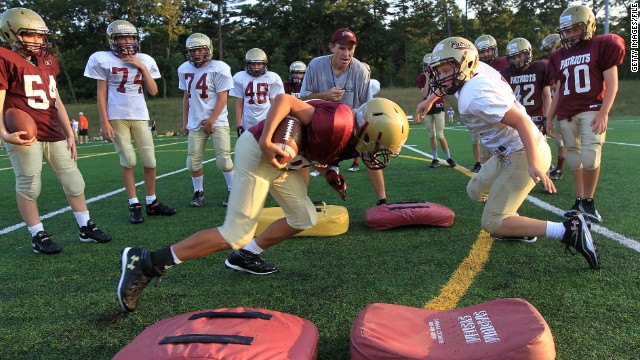
Concussions occur during youth football practice

Many concussions happen during youth football practice, a recent study claims.

Most concussions among high school and college football players occur during practice, a new study finds.
Data on more than 20,000 young football players across the United States revealed that more than 57 percent of concussed high school and college players were injured at practice, not games.
Among youth football players, almost half of concussions were sustained during practice, according to the study published online May 4 in the journal JAMA Pediatrics.
Evaluating and modifying techniques used during practice may offer opportunities for prevention, experts say.
"While it is harder to change concussion incidence during games without major rule changes, a substantial number of concussions occur during practice across all levels," said lead researcher Thomas Dompier, president of Datalys Center for Sports Injury Research and Prevention Inc., in Indianapolis.
Policy makers and coaches could reduce the odds of serious head injury by limiting player-to-player, or full body, contact during practices, Dompier said.
Dr. John Kuluz, concussion director at Nicklaus Children's Hospital in Miami, said he isn't surprised so many concussions occur during football practice.
"There are a lot of concussions occurring in practices, but of course there are a lot more practices than games," he said. Kuluz pointed out that, according to the study, younger players had about three practices for each game; high school players had about four practices for each game; and college players had nearly 10 practices for a game.
Despite the greater number of practices, games are still more dangerous in terms of head trauma, Kuluz said.
Kuluz agreed that modifying physical contact -- the main cause of concussions -- would help reduce the odds of injury.
"You can't eliminate all player-to-player contact in practice," he said. "But there are alternatives -- like hitting dummies or using sleds -- rather than hitting each other," he said.
As awareness of long-term brain trauma increases, sports-related concussions are a growing public health concern, the researchers pointed out.
Schools are more aware than ever of the risk of concussions, Kuluz said. "All the schools I talk to are aware that there is a big risk of concussion when you play football," he said.
The study results are based on an analysis of data from three sources: the Youth Football Surveillance System; the National Athletic Treatment, Injury and Outcomes Network; and the National Collegiate Athletic Association Injury Surveillance Program.
The researchers found that during the 2012 and 2013 seasons 1,198 concussions occurred -- almost 12 percent of them among youth athletes, 66 percent among high school players, and 22 percent on the college field.
In all, concussions accounted for 9.6 percent of reported youth injuries, 4 percent of high school injuries and 8 percent of college injuries, the researchers found.
During practice, concussion rates were lower among college players than among high school players, the study found.
In 2012 and 2013, youth football players had the lowest concussion risk -- less than 4 percent both seasons. The one-season concussion risk was highest in high school at nearly 10 percent, and college players at 5.5 percent, the researchers said.
Among kids ages 5 to 7 there were no football-related concussions during that study period, researchers say.
Each year, approximately 3 million youth athletes, 1.1 million high school athletes and 100,000 college athletes play football, the researchers noted.
"Across all levels of football, policy makers, coaches, researchers and sports medicine officials should continue to seek ways to reduce concussion incidence," Dompier said.
Read more here

Sunday, September 01, 2013

Concussion myths

This article discusses myths parents believe on concussions in football, and tells what the truth is.

What are some things to clear up before kids hit the fields this fall?
One myth is that if an athlete hasn't blacked out or lost consciousness, they haven't suffered a concussion.
In only about 10 percent of concussion cases does the person lose consciousness. Just because a young athlete doesn't black out does not mean that their brain has not been injured. Symptoms may include headaches, a sensation of pressure in the head, dizziness, nausea as well as mood changes, sleep disruption or loss of memory. In the article on our ParentMap website, we have more information on symptoms.
People often believe that if a child suffers a concussion, adults will know immediately.
In fact, symptoms can take minutes, hours, even a couple of days to develop. This is why it is so critical for an athlete to be benched until they can be evaluated by a certified trainer or medical professional.
Most tragedies due to concussions are preventable as long as the athlete is not exposed to further head trauma.  After a bad first hit, a second hit, even if smaller in force, can have catastrophic results such as second-impact syndrome.
Sanctioned football practices started last week, and that's what we always focus on, but are football players the only ones who need to know about the signs of concussions?
No, that's another thing to dispel. While football has the highest rate of concussion, lacrosse and hockey have high numbers -- and so do girls' soccer, lacrosse and basketball. It's not just a boy thing.
In fact, in sports where the rules of contact are the same for girls and boys, such as soccer and basketball, girls have higher rates of concussion. There are differing theories for why this is, but no definitive research to explain it.
We hear about companies making safer helmets. Do they make a difference?
No. As the University of Washington/Harborview Medical Center doctors in the Seattle Sports Concussion program will tell you over and over again, there is no such thing as a helmet that prevents concussions. Helmets can prevent skull fractures, but compare a mild traumatic brain injury to shaking Jello inside a Tupperware container. Nothing on the outside of the skull can prevent the brain inside from slamming into the hard bones of the skull.
If an adult isn't sure if a child has suffered a concussion, is it better to be safe than sorry and have them sit out?
Yes. In fact, with the Lystedt Law that's been in effect four years now, coaches who even suspect a child has suffered a concussion must pull the athlete until they get properly evaluated by a medical professional. And they have to get medical approval before returning to play. That too is key, because if their brain has not healed and they get hit again, that can be catastrophic.
Before they return to play, are they fine to go about as long as they're not doing the sport?
No, mental rest is actually very important to recovery. Doctors treating concussions will say no TV, video games, test-taking or studying because that can slow the brain's healing.
Read more here

Thursday, August 22, 2013

Concussions Occur In Youth Football Primarily During Practice, Not Games

A study claims that the majority of concussions in youth football happen during practices rather than during games.

Less contact during practice could mean a lot less exposure to head injuries for young football players, according to researchers at Wake Forest Baptist Medical Center and Virginia Tech.
Their study of 50 youth-league players ages 9 to 12 -- the largest ever conducted to measure the effects of head impacts in youth football -- found that contact in practice, not games, was the most significant variable when the number and force of head hits incurred over the course of a season were measured. Numerous studies in this area have been done on high school and college players, but those findings do not necessarily apply to younger players.
Though more than 70 percent of the football players in the United States are under age 14, there is no clear, scientifically based understanding of the effect of repeated blows to the head in young players, said Steven Rowson, Ph.D., assistant professor at the Virginia Tech-Wake Forest University School of Biomedical Engineering and lead author of the study, which is published in the current online edition of the Annals of Biomedical Engineering.
To quantify youth football players' exposure to head impacts in practices and games over the course of a single season, the researchers employed sensors in the helmets of 50 players on three teams in two different leagues.
The sensors were installed on an elastic base inside the helmet so that they remained in contact with the head throughout the duration of head impact, allowing for measurement of head acceleration rather than that of the helmet. Data from the sensors were transmitted wirelessly to a computer on the sideline and processed to measure both the linear and rotational head acceleration caused by each impact. All data were analyzed on an individual player basis and then averaged to represent the exposure level of a typical 9- to12-year-old football player.
The most important finding was that substantial differences existed among the three teams for both frequency and intensity of the impacts, Rowson said. For the entire season, players on team A experienced an average of 37 to 46 percent fewer impacts than players on teams B and C. For example, the average player on team A experienced 158 impacts during the season, compared to 294 and 251 on the other two teams. This can be attributed to several factors, but the primary reason was that team A had fewer practices during the season than teams B and C, the study showed. During games, impact frequency and acceleration magnitudes were not significantly different among the teams.
In addition, team A competed in a league that had implemented Pop Warner rule changes, including a limit on contact during practice sessions. Teams B and C had no such restrictions.
Although the practice contacts were limited, there were no differences in the head acceleration magnitudes measured in the games between all three teams. The 95 percent head accelerations ranged from 41 g to 45 g for all three teams and were not significantly different. These data show that limiting contact in practices does not create an adverse effect in games.
"It is striking that you can cut head impacts for a player in half just by modifying practice, and it does not seem to change the game," said Alexander Powers, M.D., assistant professor of neurosurgery at Wake Forest Baptist and co-author of the study. "This may be very important in kids where brains are developing."
Coaching style also had a major influence on factors such as the types of drills used in practice and the plays called in games, which would likely contribute to the differences in the head impact exposure that players experienced, the authors reported. "We hope that the findings will help improve the safety of youth football through rule changes to limit contact in practices, coach training and equipment design, especially in developing youth-specific helmets to better reduce accelerations from head impacts," Rowson said.
Funding for the study was provided by the Childress Institute for Pediatric Trauma, the National Highway Traffic Safety Administration and the Virginia Tech-Wake Forest University School of Biomedical Engineering and Sciences.
Read more here