Showing posts with label youth football. Show all posts

Wednesday, July 01, 2015

Concussions occur during youth football practice

Many concussions happen during youth football practice, a recent study claims.

Most concussions among high school and college football players occur during practice, a new study finds.
Data on more than 20,000 young football players across the United States revealed that more than 57 percent of concussed high school and college players were injured at practice, not games.
Among youth football players, almost half of concussions were sustained during practice, according to the study published online May 4 in the journal JAMA Pediatrics.
Evaluating and modifying techniques used during practice may offer opportunities for prevention, experts say.
"While it is harder to change concussion incidence during games without major rule changes, a substantial number of concussions occur during practice across all levels," said lead researcher Thomas Dompier, president of Datalys Center for Sports Injury Research and Prevention Inc., in Indianapolis.
Policy makers and coaches could reduce the odds of serious head injury by limiting player-to-player, or full body, contact during practices, Dompier said.
Dr. John Kuluz, concussion director at Nicklaus Children's Hospital in Miami, said he isn't surprised so many concussions occur during football practice.
"There are a lot of concussions occurring in practices, but of course there are a lot more practices than games," he said. Kuluz pointed out that, according to the study, younger players had about three practices for each game; high school players had about four practices for each game; and college players had nearly 10 practices for a game.
Despite the greater number of practices, games are still more dangerous in terms of head trauma, Kuluz said.
Kuluz agreed that modifying physical contact -- the main cause of concussions -- would help reduce the odds of injury.
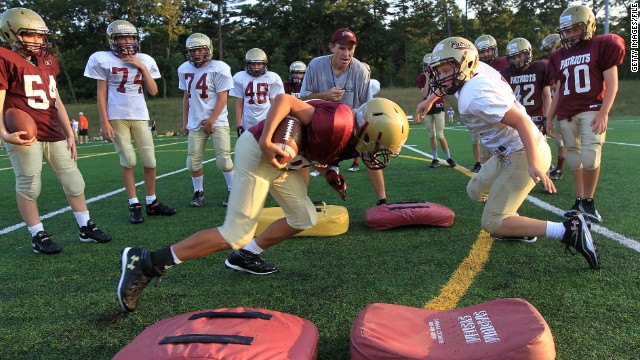
"You can't eliminate all player-to-player contact in practice," he said. "But there are alternatives -- like hitting dummies or using sleds -- rather than hitting each other," he said.
As awareness of long-term brain trauma increases, sports-related concussions are a growing public health concern, the researchers pointed out.
Schools are more aware than ever of the risk of concussions, Kuluz said. "All the schools I talk to are aware that there is a big risk of concussion when you play football," he said.
The study results are based on an analysis of data from three sources: the Youth Football Surveillance System; the National Athletic Treatment, Injury and Outcomes Network; and the National Collegiate Athletic Association Injury Surveillance Program.
The researchers found that during the 2012 and 2013 seasons 1,198 concussions occurred -- almost 12 percent of them among youth athletes, 66 percent among high school players, and 22 percent on the college field.
In all, concussions accounted for 9.6 percent of reported youth injuries, 4 percent of high school injuries and 8 percent of college injuries, the researchers found.
During practice, concussion rates were lower among college players than among high school players, the study found.
In 2012 and 2013, youth football players had the lowest concussion risk -- less than 4 percent both seasons. The one-season concussion risk was highest in high school at nearly 10 percent, and college players at 5.5 percent, the researchers said.
Among kids ages 5 to 7 there were no football-related concussions during that study period, researchers say.
Each year, approximately 3 million youth athletes, 1.1 million high school athletes and 100,000 college athletes play football, the researchers noted.
"Across all levels of football, policy makers, coaches, researchers and sports medicine officials should continue to seek ways to reduce concussion incidence," Dompier said.
Read more here

Wednesday, March 11, 2015

Experts claim better concussion prevention is needed in youth sports

This article discusses an expert's claim that better preventative measures for concussions are needed in youth sports.

Dina Morrissey, M.D., M.P.H., research associate for The Injury Prevention Center at Hasbro Children's Hospital, recently led a study that found that while compliance with mandated provisions in youth sports concussion laws was high among Rhode Island Interscholastic League (RIIL) high schools, compliance with recommended concussion protocols was very limited. The study, recently published in the Journal of Trauma and Acute Care Surgery, suggests that more concussion related standards and protocols need to be written into law in order to raise compliance rates among youth sports groups.
"An estimated 7.7 million children and adolescents participate in organized sports each year and the Centers for Disease Control and Prevention estimates that they sustain between 1.6 and 3.8 million sports-related concussions annually," said Morrissey. "In response to this, the state of Rhode Island passed the School and Youth Programs Concussion Act (SYPCA) in July 2010. The law outlines both mandatory and recommended provisions in regard to managing student athletes with a suspected concussion. Our study assessed compliance with this law among Rhode Island high schools and community league organizations."
In a 2013 statewide assessment of Rhode Island concussion law compliance among RIIL member high schools, non-member high schools and selected community league sports organizations, the study team found nearly universal compliance with mandated elements of SYPCA.
All athletic directors surveyed reported that they require concussion information sheets to be signed by both student athletes and parents prior to the start of each sports season. The research team also found that all coaches and 93 percent of volunteers have completed annual concussion training.
One hundred percent of surveyed groups also reported that any student athlete with a suspected concussion is immediately removed from play, and 93 percent reported that those students cannot return to play until they receive written clearance from a licensed physician, all per the SYPCA mandates.
"These SYPCA laws only apply to schools that are RIIL members," said Michael Mello, M.D., M.P.H., director of the Injury Prevention Center and co-author of the study. "When we explored other non-RIIL schools and sports organizations where SYPCA is recommended but not required, and also any of the recommendations that are not legally required of RIIL members, we found a very different compliance rate."
Only a handful of schools require student athletes to complete any type of pre-season neurocognitive testing, and nearly 20 percent don't offer it to student athletes at all. Half of the surveyed groups reported developing a written return to play protocol.
"These compliance statistics show us that in order to best protect youth athletes in Rhode Island, all recommendations outlined in the SYPCA law should be made mandatory," said Mello. "Additionally, non-RIIL schools, as well as community sports organizations, should also be required to comply with the law."
Neha Raukar, M.D., director of the Center for Sports Medicine and a co-author of the study, sees many youth athletes in her clinic for concussion treatment. "If a concussion is not treated properly and student athletes return to play too soon, they are at high risk for prolonging their symptoms, meaning more time out of the classroom and on the bench. They are also at risk for experiencing a devastating post-concussion event, such as second impact syndrome, which can be fatal," said Raukar.
"We are only just beginning to understand the long-term consequences of sustaining repeated head trauma and concussions," said Raukar. "Physicians, coaches and school staff alike all need to know the importance of properly diagnosing concussions, as well as the criteria for when a student athlete can both return to school and return to sports."
But, Morrissey also urges that the public needs to play a role and ensure that their school or community sports organization follows all the recommendations in the concussion law. "One example of our community pushing for better concussion protection for our students can be seen in school nurse annual training," said Morrissey. "At the time of our survey, only one quarter of surveyed groups required school nurses to complete annual concussion training. But now there is a new law in place to try to correct this, and Rhode Island is one of only a handful of states to reach out to school nurses for training. This is a clear step in the right direction."
Read more here

Friday, August 01, 2014

Katy's coaches and players taught to spot concussions

Football players and coaches in Katy, Texas are being educated to make sure they know how to spot concussions.

Players and coaches from Katy Youth Football completed their first of at least four safety training sessions Saturday to make sure all are properly educated on how to understand, as well as avoid, head trauma on the field.
Taking place at Cinco Ranch High School, Saturday’s seminar featured the “Heads Up” program, an initiative by USA Football — the sport’s national governing body — to certify that coaches know current standards for concussion awareness and equipment fit, as well as heat and hydration. Through “Heads Up”, USA Football is striving to create standards for terminology and technique from the little league level, up to the pro level.
“Where we’re seeing more concussions is actually during the tackle,” said Chad Hester, USA Football master trainer. “So we’re starting with ‘Heads Up Tackling’. We’re teaching them proper tackling techniques to get the head out of the game — where they should be making first contact, instead of the head.”
USA Football teaches players by advancing through “levels of contact”, where technique is learned through different types of resistance — beginning with air, to bags, designated winners and losers, with the final stage called “thud”. Thud is a term by USA Football used to designate an assigned drill where players stay on their feet, and all contact is above the waist — a quick whistle ending play.
KYF President Anthony Biello said 2014 is the second year for KYF to participate in Heads Up. Besides just learning technique, KYF is limiting the amount of “live-action” players participate in during practice. The 35-year old league, boasting 1,500 players, has adopted the UIL’s standard of no more than 90 minutes of full-contact per week, per player. Full-contact is defined as game speed, where players tackle and block to the ground.
“If we have coaches that are out there just banging kids into each other, we have talks with those coaches. In some cases, we remove those kinds of coaches,” Biello said. “If you’re lining two kids up, five or ten yards apart and tell them to run full-speed and hit each other head-on — we don’t want to see that happen on our fields.”
He said the league doesn’t endorse several old-school contact exercises, such as “Bull in the Ring”, where players line up in a circle around one player, targeting the man in the middle for hit after hit, or the “Oklahoma Drill”, where a blocker and ball-carrier are pitted against a defender head-on within a tight width of space.
Kenneth Podell, neuropsychologist from the Methodist Neurological Institute, came to KYF’s training to educate coaches and players on what concussions actually are, as well as how to recognize and treat them. Podell remembers when some football coaches didn’t actually consider concussions a legitimate injury.
“At one time, a concussion test might have been, ‘how many fingers am I holding up?” Podell said. He indicated that has changed, where now medical staff uses a Standardized Concussion Assessment Tool (SCAT), where players go through a variety of mental assessments, also participating in balance and coordination tests.
“We try to objectify this is much as possible,” he said.
However, if there’s even an inkling of head injury by game officials, training staff or coaches, Biello said KYF requires players to sit out for at least a week and to be cleared medically by a qualified physician before returning to play.
While lawsuits against the NFL by former players diagnosed with the disease called CTE — thought by some to be caused by multiple sub-concussive hits — have spurred the movement for concussion awareness, Podell said he considers this a different type of injury, and one that’s still being studied by doctors. At this point in time, Podell said he believes athletes from little league on to high school bare significantly less risk than college or pro players, but that every parent must access their own risk level.

Hester recommends that parents look for a USA Football certified league when signing their kids up to play, as leagues that aren’t aligned with USA Football may not have the same level of standards. He hopes through these types of trainings, players will develop muscle memory for the Heads Up techniques. USA Football is looking to add “Heads Up Blocking” to their current instruction in future years.
Read more here

Saturday, January 04, 2014

Why no helmet can prevent concussions

This comprehensive article gives an overview of the research that has been done on helmets and concussions, and the article discusses what this research means for football players.

It's a glorious time to be a football fan.
The NFL playoffs are underway, the Super Bowl is just weeks away. The national rite of football gives so many people so many exciting moments. Maybe that's why it can be hard to wrap one's mind around one of the game's huge downsides: what it may do to the brains of the young men who play it.
The spotlight on head injuries in sports, particularly football, has grown more intense in recent years. Last fall, the NFL settled for $765 million dollars in a class action lawsuit by former players over concussions, a case heard in Philadelphia.
Last week, a Mississippi father filed a federal class action suit on behalf of all student athletes asking the bodies governing college and high school sports to provide better and more uniform information on concussion risks.
Many of the sports Americans and young adults in particular love to play – not just football, but hockey, soccer and the rest – risk collisions and jolts to the head that can lead to concussions. Sometimes the signs are obvious, as was the case with Emily Panchak and Patrick Crowley, high school athletes in the Wilmington area.
"I didn't get knocked out, but I was crying, and it hurt really bad," says Panchak, who right after a head collision last spring, couldn't remember the bus ride over to the soccer game that day.
"The way I landed, the way I hit the back of my head on the ground, it just riled me pretty bad," recalls Patrick Crowley, Concord Raiders' football captain, of a concussion that put him out of play for several weeks a few years ago.
Injuries can also be more subtle, cautions Rosemarie Scolaro Moser, a neuropsychologist who runs the Sports Concussion Center of New Jersey.
"The problem with a concussion is true symptoms often don't show till hours or days later," Moser recently told The Pulse. "And with youth, they're more vulnerable to a second hit. So for example, if they haven't fully recovered and they get hit again, that second hit, even if it might not have caused a concussion to begin with on its own, can cause serious damage."
Searching for the magic bullet
Trying to change how games are played to avoid collisions has proven difficult and controversial. It has led to a search for the magic bullet, in hopes of sharply reducing the risk of concussion: better equipment. In football, this often means the helmet.
Some companies have marketed claims to young athletes their headgear could be the better mousetrap.
At Schuylkill Valley Sports in Easton, Pa., Mike Morris estimates two to three high school football players per team have come in to buy their own, more expensive, helmet this past season.
"They're looking to get something better," says Morris. "They're just looking for something that will minimize the risk of concussion."
But do any football helmets really cut down the risk of concussion? And are certain models worth the extra money?
What role do helmets play? 
Halfway across the country, Alison Brooks had a similar experience to Mike Morris at Schuylkill Valley Sports. Brooks specializes in sports medicine at the University of Wisconsin. Parents and young athletes kept asking her which helmets they should get. Many were feeling pressure at school to buy newer ones.
So she designed a prospective study, observing over 1,000 high school football players last year who wore the three most common helmets, including some of the newest models. She parsed out the number of reported concussions based on helmet brand, model and age, to see if there was any big variation.
There wasn't.
"You know as best we can tell they all adequately do what they were designed to do, which is prevent skull fractures, prevent intracranial bleeds, prevent superficial scalp and face injuries," Brooks recently told The Pulse. "But there's not any evidence that any one of them is particularly going to reduce your concussion risk."
Brooks' findings are preliminary, and may not account for other possible external factors. But the results don't surprise Robb Rehberg, a concussion specialist and professor of athletic training at William Patterson University in New Jersey. Rehberg thinks some helmets are doing a better job at protecting the head and "attenuating the forces that typically cause concussion," but while helmet design has improved a lot compared to ten years ago none can, nor should, claim to prevent a concussion.
Other research points to similar takeaways.
Evidence limited
In general, scientists don't know how effective helmets are when it comes to concussions in kids ages 5 to 21.
Kristy Arbogast and Susan Margulies reviewed all the evidence to date for a recent Institute of Medicine Report: Sports-Related Concussions in Youth – Improving the Science, Changing the Culture. Margulies, a bioengineer at the University of Pennsylvania, says part of the challenge is the science behind concussions isn't there yet. There's no standard, objective way for actually identifying and reporting them.
"Evidence that a concussion has occurred is really entirely based on the athlete saying that I think I've had a head injury," says Margulies.
So imagine trying to diagnose an ACL tear and come up with a rehab plan solely on the athlete's description of knee pain rather than an MRI, where the actual injury can be objectively visualized. The IOM report points to another major challenge when it comes to identifying concussions: the culture of sports and pressure to hide injuries.
"Probably one of the most important things we stress to the kids is you have to be honest," George Kasonovich recently told The Pulse.
Kasonovich, head football coach at Concord High School in Delaware, says schools have much better protocols nowadays,thanks to improved education, regulations and awarenessregarding concussions. If one is even suspected on the field, a player's out and can't return without a physician's note.
But Kasonovich's mindset isn't universal. And, athletes also face a lot of pressure to hide injuries. Seniors Patrick Crowley and Keyon Powell are Concord's co-captains. Both have suffered from concussions in the past, and had to sit out for several weeks.
"Some of the worst people to talk to about that are your teammates and your friends because they're always going to want you go out there no matter what you're feeling," says Crowley.
"It's basically the pride of it, you don't want to sit on the sideline, you always want to be out there helping your teammates," says Powell.
It makes the job of the school's athletic trainer, Scott Klabunde even trickier. He doesn't joke around.
"I'm not going to lie, I've threatened them," says Klabunde. "It was 'hey, if you really screw this up, you could die.'"
Technology outpacing science
While helmets do protect against head injuries like skull fractures, relying on them to prevent concussions is problematic for another reason: the limitations in how helmets are assessed.
Arbogast, with the Children's Hospital of Philadelphia, says helmet standards and effectiveness have historically been based on a drop test.
"They take a helmet, they put a humanoid head form - a plastic rubber head form in the helmet - and they drop it a given height and measure its acceleration," says Arbogast. "And there are thresholds below which every helmet must meet."
But in the real world you don't always hit your head in a straight line that way. Arbogast and Margulies both say the manor and direction your head moves are big factors in developing a concussion.
"We know it's a combination of linear movements along a straight line and rotational movements," says Arbogast. "But we don't know the specific level, the magnitude of those movements."
"Nodding your head yes verses 'I don't know' are two rotational motions," says Margulies. "They could have very different risks associated with concussion.
Those concussion risks could also vary based on a kids' age and individual experience. No one hit and reaction is alike. The science, they say, just hasn't caught up with the product development.
"And so without that fundamental data we can't really answer a question about whether a given helmet protects against concussion or not," says Arbogast.
"Current helmets may mitigate rotational accelerations, but we're not measuring it now," Margulies adds.
For the recent IOM youth concussion report, Margulies and Arbogast also examined other kinds of protective equipment, like facial masks and mouth guards. They found no evidence those devices reduce concussion risk, though they are important when it comes to protecting against other kinds of injuries.
Their chapter notes that solely relying on helmets as a way to reduce concussions might have another unintended effect, a phenomenon called "risk compensation" which has been studied a lot in safety literature: "the athlete may be emboldened by the increased protection to take additional risks, thus mitigating any benefits of the protective device."
More to preventing concussions
Despite helmet limitations, concussion specialists caution against relying only on that bit of equipment to prevent or lessen the risk of getting a concussion, anyway.
"The helmet isn't all of the story here," says Arbogast. "We need to understand how particular practice methods or aspects of the game might be able to be modified to protect the head."
Arbogast says that includes teaching different tackling techniques, and developing strategies that go well beyond the playing field, in terms of education and following up for when a concussion occurs, to ensure a full a recovery.
Read more here

Thursday, November 07, 2013

Self-reporting concussions in youth sports is dealing with a "culture of resistance"

Youth sports are currently trying to deal with the "culture of resistance" that has formed around self-reporting concussions.

Young athletes in the U.S. face a "culture of resistance" to reporting when they might have a concussion and to complying with treatment plans, which could endanger their well-being, says a new report from the Institute of Medicine and National Research Council. The report provides a broad examination of concussions in a variety of youth sports with athletes aged 5 to 21. Overall, reported concussions rates are more frequent among high school athletes than college athletes in some sports -- including football, men's lacrosse and soccer, and baseball; higher for competition than practice (except for cheerleading); and highest in football, ice hockey, lacrosse, wrestling, soccer, and women's basketball. Concussion rates also appear higher for youths with a history of prior concussions and among female athletes.
Although the committee that wrote the report examined useful scientific information to inform its study, it discovered that research about youth concussions is limited. To address these gaps in knowledge, the committee identified several areas for further research, including establishing a national surveillance system to accurately determine the number of sports-related concussions, identifying changes in the brain following concussions in youth, conducting studies to assess the consequences and effects of concussions over a life span, and evaluating the effectiveness of sports rules and playing practices in reducing concussions.
"The findings of our report justify the concerns about sports concussions in young people," said Robert Graham, chair of the committee and director of the national program office for Aligning Forces for Quality at George Washington University, Washington, D.C. "However, there are numerous areas in which we need more and better data. Until we have that information, we urge parents, schools, athletic departments, and the public to examine carefully what we do know, as with any decision regarding risk, so they can make more informed decisions about young athletes playing sports."
The committee found little evidence that current sports helmet designs reduce the risk of concussions. It stressed that properly fitted helmets, face masks, and mouth guards should still be used, because they reduce the risk of other injuries -- such as skull fractures; bleeding inside the skull; and injuries to the eyes, face, and mouth. The marketing for some protective devices designed for youth athletes, such as mouth guards and headbands for soccer, has advertised that these devices reduce concussion risk, but there is a lack of scientific evidence to support such claims, the committee said.
The committee examined scientific literature on concussion recognition, diagnosis, and management and found that the signs and symptoms of concussion are usually placed into four categories -- physical, cognitive, emotional, and sleep -- with patients experiencing one or more symptoms from one or more categories. Typically, youth athletes recover from a concussion within two weeks of the injury, but in 10 percent to 20 percent of cases concussion symptoms persist for a number of weeks, months, or even years. A potentially concussive injury requires removing the athlete from play, caring for the injury appropriately in both the acute stage and during the recovery process, and returning to play only when he or she has recovered demonstrably and is no longer having any symptoms, the committee said. An individualized treatment plan that includes physical and mental rest may be beneficial for recovery from a concussion, but current research does not indicate a standard or universal level and duration of rest needed. Athletes who return to play before their brain has fully healed may place themselves at increased risk for prolonged recovery or more serious consequences if they sustain a second brain injury.
The committee examined data on the effects of single and multiple concussions and found some observed impairments in the areas of memory and processing speed. It also determined that a history of previous concussions is a predictor of increased risk for future concussions, although the extent to which the risk is increased is unknown. In several studies, the number and severity of concussion symptoms is greater in athletes with a history of two or more concussions. Additionally, athletes with a history of prior concussions may have more severe subsequent concussions and may take longer to recover. The time interval between concussions may also be an important factor in the risk for and the severity of subsequent concussions. Whether repetitive head impacts and multiple concussions sustained in youth lead to long-term neurodegenerative disease, such as Chronic Traumatic Encephalopathy (CTE), remains unclear.
The committee reviewed surveys of retired professional athletes, which provided some evidence that a history of multiple concussions increases risk for depression. In a survey of more than 2,500 retired professional football players, approximately 11 percent reported having a prior or current diagnosis of clinical depression. Very little research has evaluated the relationship between concussions and suicidal thoughts and behaviors. There currently are no data to evaluate this relationship because existing post-concussion symptom evaluations do not assess suicidal thoughts.
Some studies have shown that enforcement of sports rules by coaches and officials and adherence to these rules by players may help reduce the incidence and severity of sport-related concussions in youths. Several organizations have called for a "hit count" in youth sports to limit the amount of head contact a particular player should experience over a given amount of time. While the concept of limiting the number of head impacts is fundamentally sound, the committee found that implementing a specific threshold for the number of impacts or the magnitude of impacts per week or per season is without scientific basis.
The committee included additional noteworthy findings in the report:
  • The reported number of individuals aged 19 and under treated in U.S. emergency departments for concussions and other non-fatal, sports- and recreation-related TBIs increased from 150,000 in 2001 to 250,000 in 2009.
  • Football, ice hockey, lacrosse, wrestling, and soccer are associated with the highest rates of reported concussions for U.S. male athletes at the high school and college levels.
  • Soccer, lacrosse, and basketball are associated with the highest rates of reported concussions for U.S. female athletes at the high school and college levels. Women's ice hockey at the collegiate level has the highest rate of reported concussions.
  • Youths with a history of prior concussion have higher rates of reported sports-related concussions.
  • Among military personnel, mild traumatic brain injuries, of which concussions are one category, represent about 85 percent of all TBIs.
  • Among military personnel, about 80 percent of mild TBIs do not occur in the deployed setting and are commonly caused by automobile crashes involving privately owned and military vehicles, falls, sports and recreation activities, and military training.
Read more here

Sunday, September 15, 2013

New York's Attorney General releases consumer alert on helmets

New York Attorney General released a statement alerting people to the fact that no helmet can prevent youth concussions.

New York Attorney General Eric Schneiderman issued a consumer alert Thursday about the risk of concussions to youth football players.
Schneiderman
Schneiderman
Schneiderman reminded consumers that head injuries, such as concussions, can happen at any time on the football field, no matter what helmet is worn. Any claims suggesting a certain helmet is anti-concussive or concussion-proof may be misleading and possibly dangerous if they give parents and players a false sense of security.
Parents, coaches and young football players should instead rely on tips and strategies to reduce the risk of head injuries. Such strategies include learning and recognizing the symptoms of a concussion, reducing head-to-head hits on the field and enforcing more stringent penalties against such behavior.
“It’s important to remember that no helmet can fully prevent a concussion,” Schneiderman said. “Ensuring that manufacturers don’t mislead the public and endanger young New Yorkers is a key concern for my office. Just as important, we must work to educate young athletes and their parents about how to reduce the risk of concussion and detect early warning signs on the field.”
New York State’s Concussion Management and Awareness Act, which became effective in July 2012, requires training for athletic trainers, school nurses, physical education teachers and coaches in the symptoms and risks of concussion.
A recent Virginia Tech University study of seven- and eight-year-old football players found that youth players recorded impacts to the head with severity levels compared to players found in collegiate football, even though young players play at slower speeds and have less body mass. According to the National Federation of State High School Athletic Associations, about 3.5 million children between the ages of six and 14 play in youth football leagues in the United States.
Read more here

Sunday, September 01, 2013

Concussion myths

This article discusses myths parents believe on concussions in football, and tells what the truth is.

What are some things to clear up before kids hit the fields this fall?
One myth is that if an athlete hasn't blacked out or lost consciousness, they haven't suffered a concussion.
In only about 10 percent of concussion cases does the person lose consciousness. Just because a young athlete doesn't black out does not mean that their brain has not been injured. Symptoms may include headaches, a sensation of pressure in the head, dizziness, nausea as well as mood changes, sleep disruption or loss of memory. In the article on our ParentMap website, we have more information on symptoms.
People often believe that if a child suffers a concussion, adults will know immediately.
In fact, symptoms can take minutes, hours, even a couple of days to develop. This is why it is so critical for an athlete to be benched until they can be evaluated by a certified trainer or medical professional.
Most tragedies due to concussions are preventable as long as the athlete is not exposed to further head trauma.  After a bad first hit, a second hit, even if smaller in force, can have catastrophic results such as second-impact syndrome.
Sanctioned football practices started last week, and that's what we always focus on, but are football players the only ones who need to know about the signs of concussions?
No, that's another thing to dispel. While football has the highest rate of concussion, lacrosse and hockey have high numbers -- and so do girls' soccer, lacrosse and basketball. It's not just a boy thing.
In fact, in sports where the rules of contact are the same for girls and boys, such as soccer and basketball, girls have higher rates of concussion. There are differing theories for why this is, but no definitive research to explain it.
We hear about companies making safer helmets. Do they make a difference?
No. As the University of Washington/Harborview Medical Center doctors in the Seattle Sports Concussion program will tell you over and over again, there is no such thing as a helmet that prevents concussions. Helmets can prevent skull fractures, but compare a mild traumatic brain injury to shaking Jello inside a Tupperware container. Nothing on the outside of the skull can prevent the brain inside from slamming into the hard bones of the skull.
If an adult isn't sure if a child has suffered a concussion, is it better to be safe than sorry and have them sit out?
Yes. In fact, with the Lystedt Law that's been in effect four years now, coaches who even suspect a child has suffered a concussion must pull the athlete until they get properly evaluated by a medical professional. And they have to get medical approval before returning to play. That too is key, because if their brain has not healed and they get hit again, that can be catastrophic.
Before they return to play, are they fine to go about as long as they're not doing the sport?
No, mental rest is actually very important to recovery. Doctors treating concussions will say no TV, video games, test-taking or studying because that can slow the brain's healing.
Read more here

Thursday, August 22, 2013

Concussions Occur In Youth Football Primarily During Practice, Not Games

A study claims that the majority of concussions in youth football happen during practices rather than during games.

Less contact during practice could mean a lot less exposure to head injuries for young football players, according to researchers at Wake Forest Baptist Medical Center and Virginia Tech.
Their study of 50 youth-league players ages 9 to 12 -- the largest ever conducted to measure the effects of head impacts in youth football -- found that contact in practice, not games, was the most significant variable when the number and force of head hits incurred over the course of a season were measured. Numerous studies in this area have been done on high school and college players, but those findings do not necessarily apply to younger players.
Though more than 70 percent of the football players in the United States are under age 14, there is no clear, scientifically based understanding of the effect of repeated blows to the head in young players, said Steven Rowson, Ph.D., assistant professor at the Virginia Tech-Wake Forest University School of Biomedical Engineering and lead author of the study, which is published in the current online edition of the Annals of Biomedical Engineering.
To quantify youth football players' exposure to head impacts in practices and games over the course of a single season, the researchers employed sensors in the helmets of 50 players on three teams in two different leagues.
The sensors were installed on an elastic base inside the helmet so that they remained in contact with the head throughout the duration of head impact, allowing for measurement of head acceleration rather than that of the helmet. Data from the sensors were transmitted wirelessly to a computer on the sideline and processed to measure both the linear and rotational head acceleration caused by each impact. All data were analyzed on an individual player basis and then averaged to represent the exposure level of a typical 9- to12-year-old football player.
The most important finding was that substantial differences existed among the three teams for both frequency and intensity of the impacts, Rowson said. For the entire season, players on team A experienced an average of 37 to 46 percent fewer impacts than players on teams B and C. For example, the average player on team A experienced 158 impacts during the season, compared to 294 and 251 on the other two teams. This can be attributed to several factors, but the primary reason was that team A had fewer practices during the season than teams B and C, the study showed. During games, impact frequency and acceleration magnitudes were not significantly different among the teams.
In addition, team A competed in a league that had implemented Pop Warner rule changes, including a limit on contact during practice sessions. Teams B and C had no such restrictions.
Although the practice contacts were limited, there were no differences in the head acceleration magnitudes measured in the games between all three teams. The 95 percent head accelerations ranged from 41 g to 45 g for all three teams and were not significantly different. These data show that limiting contact in practices does not create an adverse effect in games.
"It is striking that you can cut head impacts for a player in half just by modifying practice, and it does not seem to change the game," said Alexander Powers, M.D., assistant professor of neurosurgery at Wake Forest Baptist and co-author of the study. "This may be very important in kids where brains are developing."
Coaching style also had a major influence on factors such as the types of drills used in practice and the plays called in games, which would likely contribute to the differences in the head impact exposure that players experienced, the authors reported. "We hope that the findings will help improve the safety of youth football through rule changes to limit contact in practices, coach training and equipment design, especially in developing youth-specific helmets to better reduce accelerations from head impacts," Rowson said.
Funding for the study was provided by the Childress Institute for Pediatric Trauma, the National Highway Traffic Safety Administration and the Virginia Tech-Wake Forest University School of Biomedical Engineering and Sciences.
Read more here