A brain imaging study of youth hockey players shows early markers for concussion damage.
James Hudziak, M.D., has two children who love ice hockey. His son skates for his college team and one of his daughters plays in high school.
As a pediatric neuropsychiatrist and director of the Vermont Center for Children, Youth and Families at the University of Vermont (UVM) College of Medicine, Hudziak believes in the benefits of ice hockey and other sports for kids. Athletic activities help a young person build organizational skills, improve motor and emotional control, reduce anxiety and boost confidence.
Now, though, Hudziak is looking into the potential dangers of ice hockey for young athletes. He and UVM colleagues Matthew Albaugh, Ph.D., Catherine Orr, Ph.D., and Richard Watts, Ph.D., have published a groundbreaking study in the February issue of TheJournal of Pediatrics that shows a relationship between concussions sustained by young ice hockey players and subtle changes in the cortex, the outer layer of the brain that controls higher-level reasoning and behavior.
Each year, more than 300,000 sports-related concussions (SRC) occur across all sports and all levels in the United States, according to a 2013 "Ice Hockey Summit II" report to which Hudziak and Boston University (BU) School of Medicine's Ann McKee, M.D., contributed. The report's authors advised the elimination of head hits from all levels of hockey, a change in body-checking policies and the elimination of fighting in all amateur and professional hockey. "Ice hockey SRC prevalence is high," the report states. "Hockey players compete at high speeds as they mature, risking injury from intentional and accidental collisions, body checks, illegal on-ice activity and fighting."
The UVM team used advanced imaging technology and cognitive testing to assess 29 Vermont ice hockey players between ages 14 and 23, some diagnosed with a sports-related concussion. As the severity of the athletes' concussion symptoms increased, the researchers found, the cortex got thinner in areas where it should be dense at those players' ages -- areas that relate to attention control, memory, and emotion regulation.
"We believe that injury to a developing brain may be more severe than injury to an adult brain," Hudziak says.
What the study indicates for the future health and function of an ice hockey player is unclear. The researchers hope to do further studies, ideally following the brains of these athletes over a couple of decades and factoring for their involvement and time in the sport as well as other influences, such as smoking and alcohol use.
"The concern is that what we are finding may be an early marker of brain damage," Albaugh says. "Years of playing contact sports and repeatedly getting your head knocked around probably isn't good for the brain, especially in young children whose brains are still maturing" he adds.
Their findings contribute to research into the consequences of brain injury in other sports, including the brain damage discovered in older professional football players by McKee, a neurology and pathology professor at BU and director of the "brain banks" in various centers of study for the university and the Veterans Administration. Her work was a cornerstone of "League of Denial: The NFL's Concussion Crisis," an investigative report by the public television program "Frontline" on the National Football League's response to players' brain trauma.
"It just adds to our information base about young athletes playing contact sports," McKee says of Hudziak's study. "It's a first step. It needs to be looked at longitudinally. We need to know if these athletes recover."
McKee says she wouldn't necessarily expect the brain changes in young hockey players to lead to chronic traumatic encephalopathy (CTE), a serious but uncommon disease that she found prevalent in retired NFL players. Instead, she expects that further study in the ice hockey arena will show that young players' brains can recover from early blows. Brains have a chance for rehabilitation after injury, she says.
"We're hopeful that these changes can be reversed," she says of the cortex thinning observed in Hudziak's study. "I would look at this as an opportunity to make a difference, and not a cause of irrevocable damage in these players."
Hudziak and his UVM colleagues would like to help the organizations running professional, collegiate, junior and youth hockey leagues make better decisions about how best to treat players' head injuries; how and when to return players to the ice after an injury; when to pull them from the sport entirely; and how to prevent injuries from occurring. Players and coaches at the national, college and youth levels of hockey have talked to Hudziak about his findings, he says.
In Hudziak's study, he and his colleagues cite research indicating "that cerebral concussion accounts for 15 to 22.2 percent of all reported injuries" in hockey.
The key challenges for them, says Hudziak, are that the definition of "concussion" is so slippery and reports of the incidence of concussions are inconsistent. Some people think a concussion happens when someone is hit in the head or gets dizzy; others think a person has to be "knocked out" to have a concussion.
His study focuses on the symptoms recorded after a diagnosed concussion. But Hudziak wonders whether lesser head injuries, what he calls sub-concussive events, could have as many or more consequences for the brain over time as a single major blow.
On the computer in his office, Hudziak shows a video of a professional hockey game during which a player gets body checked. It doesn't look like a very serious hit, though he's carried off the ice.
Then, the video reverses to just a few minutes earlier in the game, when that same player collides with another and flips violently backwards, throwing off his helmet before his head hits the ice. That suggests the potential harm inside a person's skull that can occur from cumulative assault.
As Hudziak puts it, "The sum is greater than the individual parts."
That player flew into Burlington, Vt. to meet with Hudziak and his team, so they can learn more from his brain.
Ideally, Hudziak says, they want to apply their current study to female and male ice hockey players ages 8 to 14, then to college-age skaters of both genders and finally to retired professional hockey players. They'd like to compare their findings at each age group to nonathletes and to the same groups in soccer -- a sport typically involving less-severe head injuries.
"We don't have any sense that hockey's going to be worse than soccer," Hudziak points out.
Already, in a follow-up study, Hudziak's team has found more evidence of increased problems in the brains of athletes, compared with nonathletes. This work focuses on "hyperintensities," which look like little bright white spots on a brain image. His research suggests a higher volume of these bright spots may correlate with decreased thickness in the cortex.
"As a general rule of thumb, you're allowed one of these bright spots every 10 years of your life," Albaugh says.
So a 50-year-old should have about five of these bright spots. One of the college-age athletes in the study has 18 spots, Albaugh says. Hudziak now has to call some parents to tell them of the "clinically concerning findings" in their children's brain images.
Hudziak doesn't want to warn parents to keep their kids out of hockey or other team play. As the founder of the unique Vermont Family-Based Approach, which incorporates all aspects of a child's life to address emotional and behavioral problems, he prescribes hockey, soccer and other sports to help eliminate behavior, attention and psychological disorders. It is his hope that through brain training and health promotion the brain may recover.
"My goal is not to rid the world of these sports," Hudziak says. "My goal is to make these sports safer, so that more people can play them."
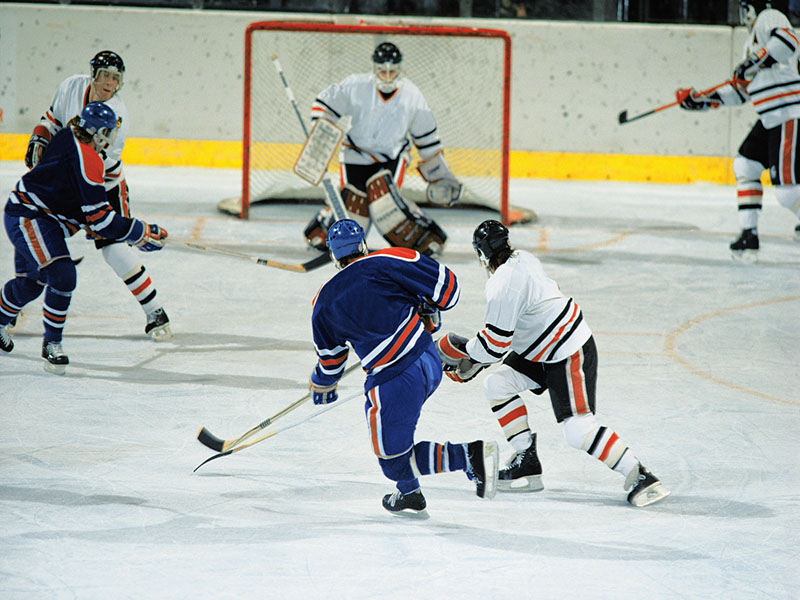 Concussions in youth hockey are more likely to occur during illegal hits.


