Showing posts with label NICU. Show all posts

Thursday, September 25, 2014

Caffeine therapy, preemies, and sleep trouble

A study found that preemies are at risk for having sleep issues and sleep disorders later in life, regardless of any caffeine therapy they may have had in the NICU.

Using caffeine to treat premature newborns for apnea - dangerous pauses in breathing during sleep - does not have long-term harmful effects on their sleep or breathing patterns, according to research led by Children's Hospital of Philadelphia. 


But the new study also found that prematurity itself is a risk factor for sleep disorders years later. Children born preterm had high rates of obstructive sleep apnea and periodic limb movement during sleep, whether or not they had caffeine therapy in the neonatal intensive care unit.
The very idea of caffeinating fragile preemies may sound misguided. But eight years ago, an international study that compared the stimulant to a placebo found it had benefits, including relieving sleep apnea.
Still, there were lingering concerns. Caffeine works in the brain, blocking a molecule that promotes sleep. Animal studies suggest that such early biochemical tinkering can lead to permanent sleep and breathing abnormalities.
"I think we all know from daily life the effect that caffeine has on us," said lead author Carole L. Marcus, a pediatric pulmonologist and director of the sleep center at Children's Hospital. "We give the equivalent of six cups of coffee a day for a week or more - and these are little babies whose brains are still developing."
The new study, published Friday in the American Journal of Respiratory and Critical Care Medicine, tracked down 201 of the original 2006 premature babies, now ages 5 to 12. Half had gotten caffeine therapy, the other half a placebo.
For two weeks, the children wore a noninvasive sensor at night to monitor their sleep. The parents also filled out questionnaires.
There were no differences in the children's sleep patterns, including how long they took to fall asleep and how soundly they slept.
But both caffeine and placebo groups had high rates of sleep disorders. Overall, about 10 percent had periodic limb movement disorder (episodes of involuntary movement, usually of the legs), and 14 percent had obstructive sleep apnea. In general, less than 4 percent of school-age children have apnea, and 5 percent to 8 percent have the limb movement disorder.
Obstructive sleep apnea is different from the apnea of prematurity. In the obstructive form, the throat airway collapses or becomes blocked. In preemies, breathing stops because their immature nervous systems cannot yet enable continuous respiration.
Obstructive apnea can lead to daytime sleepiness, learning problems, high blood pressure, and heart disease. Limb movement disorder is less understood but has been linked to attention deficit hyperactivity disorder and a serious sleep problem called restless leg syndrome.
If caffeine isn't a culprit, why are sleep disorders common in former premature babies?
One possibility, the researchers noted, is enlarged tonsils. About a quarter of the children had already undergone tonsillectomies, the primary treatment for childhood obstructive sleep apnea.
"We're thinking the rate of apnea would have been even higher if not for the tonsillectomies," Marcus said.
The limb movement may be related, at least partly, to iron deficiency. Low blood iron levels were found in the children with the movement disorder who underwent testing.
All the children with apnea or limb movement disorder were referred for more testing and treatment, but most former preemies are not even checked for such problems. The study suggests that should change.
"We should be screening these children," Marcus said. "Then we could prevent problems, or treat them earlier."
Read more here

Monday, October 08, 2012

Obese Pregnant Women Who Have Sleep Apnea May Have Delivery Complications

This article looks at the relationship between obese pregnant women with sleep apnea and delivery complications resulting in the infant staying in the ICU.
The newborns of obese pregnant women with obstructive sleep apnea, a disorder that causes disrupted sleep and pauses in breathing during the night, are more likely to be admitted to a neonatal intensive care unit, according to new research.
The study, published online in the journal Obstetrics & Gynecology, also found that sleep apnea was linked to higher rates of preeclampsia among very overweight women.
"Our findings show that obstructive sleep apnea can contribute to poor outcomes for both obese mothers and their babies," study lead author Dr. Judette Louis, a maternal-fetal medicine specialist and assistant professor of obstetrics and gynecology at the University of South Florida, said in a school news release.
"Its role as a risk factor for adverse pregnancy outcomes independent of obesity should be examined more closely," added Louis, who conducted the study while a faculty member at Case Western Reserve University's School of Medicine.
The researchers examined 175 obese pregnant women enrolled in a study that had screened them for sleep-related breathing disorders. The women were provided with a portable device to use at home to test for obstructive sleep apnea.
The study also analyzed more than 150 live births to track admissions to neonatal intensive care units, prematurity, congenital defects and respiratory problems among the newborns.
Roughly 15 percent of the women had sleep apnea. These women were more overweight and had more chronic high blood pressure than the women without the sleep disorder. Pregnant women with sleep apnea were more likely to have a Cesarean delivery and develop preeclampsia, a serious condition that results in high blood pressure and protein in the urine.
Although there was no difference among rates of preterm births among the women, the newborns of women with sleep apnea were more likely to be sent to the neonatal intensive care unit. Most often, these babies were admitted due to respiratory distress. The researchers pointed out that the greater number of C-section deliveries could also play a role in the higher neonatal intensive care unit admission rates.
Screening for sleep-disordered breathing among pregnant women should be improved, the researchers concluded.
Although the study found an association between obesity, sleep apnea and pregnancy complications, it did not prove a cause-and-effect relationship.
Read more here

Monday, February 27, 2012

Use of cooling blanket spurs new infant brain research into optimal care


Pediatric neurologists and neonatologists in Vanderbilt’sNeonatal Intensive Care Unit(NICU) are conducting research that may better define what happens in the brains of newborns who have suffered from oxygen deprivation, and what brain cooling therapy can achieve.
Use of a “cooling cap” within six hours is now the standard of care when an otherwise healthy, full-term infant experiences a serious lack of oxygen, called anoxic brain injury. The therapy uses cool water to bring the temperature of the brain down about five degrees. Vanderbilt took part in the initial studies of the cooling cap, which was found to reduce serious long-term brain damage and death by about one-third.
Now a switch has been made to a cooling blanket instead of a cap. The blanket is as effective in its brain-protecting capacity, but it offers researchers an opportunity to better assess what is happening in the brain as it is cooled.

Easier to monitor babies’ brains

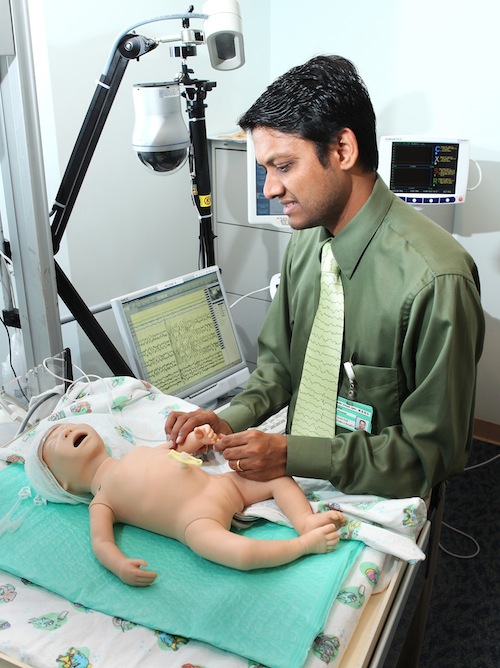
Pediatric neurology chief resident Siddharth Jain said by using a cooling blanket, the scalp is free for him to apply a full, nine-lead electro encephalogram (EEG) monitor along with a newer device called a near-infrared spectroscopy (NIRS) monitor to find out what is going on beneath a baby’s scalp.
The EEG can detect seizures, while NIRS measures how the brain uses oxygen. The information collected so far has been surprising.
“We already know the EEG detects seizures that cannot be seen in these babies. Up to 80 percent of seizures in babies with anoxic brain injury have no overt clinical signs. Other studies have shown that these babies can have between 100 and 120 seizures during the first 72 hours of life,” Jain said.
“These seizures are different than those in epilepsy. They are very aggressive in the first 48 hours and difficult to control. We don’t know for sure, but the consensus is the seizures themselves cause further damage.”
Jain is working with Barbara Engelhardt, associate professor of neonatology, to closely examine what is happening in the first 72 hours after an anoxic injury — the critical window of opportunity in which the cooling seems to have its maximum brain-preserving effect.
For this observational study, William Walsh, neonatologist and director of nurseries, switched the NICU to the cooling blanket to allow the researchers to enroll the one or two babies brought to Vanderbilt every month with anoxic brain injury.

Speeding up evaluation and treatment

The first goal is to use EEG and NIRS to more quickly and accurately predict the severity of the anoxic injury. Currently, an MRI is used to give doctors a peek at structural damage in the brain, once the initial injury has stabilized, to assess long-term changes. But the predictive value of long term damage is not very great.
Engelhardt says EEG and NIRS provide information from day one about seizure activity as well how the brain is using oxygen.
These two pieces of information can describe changes after the initial injury, and may help provide a better measure of the effects on long-term outcomes.

Enables researchers to test new therapies

A second goal is to use the monitors to test new therapies. The hope is the monitors could more quickly assess the effectiveness of therapies is controlling seizures, or better balancing nutrient consumption after injury in the hope of further reducing the risk of permanent brain damage.
“When a brain cell is injured, it can go one of two ways: it can die or recover,” Walsh said. “The goal is to limit damage to as small an area as possible.
“The cooling cap was a general way to slow down the potential for further damage, but in the 15 years we have been using it, we have learned a lot about what is happening biochemically in anoxic injury and how we can further impact that damage.”

Saturday, February 11, 2012

Why Brain Injuries Are More Common In Preemies


Why Brain Injuries Are More Common In Preemies


The most common cause of brain injury in premature infants is a lack of oxygen in the days and weeks after birth, researchers say.
Scientists say they are beginning to understand why brain injuries are so common in very premature infants — and they are coming up with strategies to prevent or repair these injuries.
The advances could eventually help reduce the number of premature babies who develop cerebral palsy, epilepsy or behavioral disorders such as ADHD, researchers told the Society for Neuroscience meeting in Washington, D.C., this week.
Each year more than 60,000 babies are born weighing less than 3.3 pounds. And because of advances in neonatal medicine over the past several decades, most of those babies will survive. But researchers have had less success finding ways to prevent brain damage in these infants.
"That means that overall rates of cerebral palsy and other neurodevelopmental disabilities are on the rise," says David Rowitch, chief of neonatology at the University of California, San Francisco.
The most common cause of brain injury in premature infants is a lack of oxygen in the days and weeks after birth, Rowitch says. The lack of oxygen damages white matter, which provides the "communication highways" that carry messages around the brain and to distant parts of the body, he says.
 
And the babies at greatest risk of this sort of brain damage are those born after as little as six months of gestation, Rowitch says.
"Such a baby would weigh about a pound and would fit into the palm of your hand," he says. "As you can imagine, they're very fragile and vulnerable to stresses."
Those stresses often include periods when an infant's immature lungs are not delivering enough oxygen to the brain, even with help from a mechanical breathing device.
This lack of oxygen appears to damage the most common type of white matter, myelin, which acts like an insulator around the nerve fibers that carry messages in the brain and nervous system. Without enough myelin, short circuits can prevent these messages from getting through, Rowitch says.
He initially found evidence of white matter damage by studying brains from premature infants who died. But since then, he's been able to assess premature infants using a special incubator designed to fit in an MRI scanner.
"We've been able to now take over 250 babies who are very preterm to the MRI scanner safely to show that this is a feasible way to detect white matter injury early on," he says.
Now the question is how to prevent or repair that sort of injury.
Some studies show that it's important to act right away, says Vittorio Gallo from Children's National Medical Center in Washington, D.C.
"There is a very critical developmental time window right after birth," Gallo says. "If development is disturbed during this critical time window then the brain doesn't catch up."
Gallo is part of a team of scientists who have shown that it is possible to intervene — at least in mice. One approach involves giving the mice a drug that speeds up production of myelin, he says.
"We do this intervention right after the injury," he says. "And we found that by targeting specific targets we can recover and regenerate at least part of these cells right after the injury, during that critical developmental time window."
Any drug for people is still years off, Gallo says
But other scientists at the meeting say there are promising treatments available now. These include everything from the magnetic stimulation of certain areas of the brain to temporarily lowering the body temperature of premature infants to protect brain tissue.


Full story here

Friday, October 21, 2011

Newborn preemies more vocal when parents are near


Even tiny preemies hospitalized after birth can make baby sounds -- especially when their parents are talking to them, a small study suggests.

Very premature babies are known to be slower-than-average in picking up language skills. That can be due to various reasons, including health problems they may have as newborns.

It's not known whether the sounds preemies hear soon after birth, and their own ability to vocalize, are related to their later language development. But premature infants who spend their early days in the neonatal intensive care unit (NICU) are in a much different sound environment than they would be if still in the womb, said Dr. Melinda Caskey, a pediatrician at Women and Infants Hospital in Providence, Rhode Island, and the lead researcher on the new study.

In the womb, mom's voice is the most prominent sound, Caskey said. In the NICU, the beeps and whirs of medical equipment abound.

Until now, though, no studies had looked at how much language NICU preemies hear during their day.

Caskey's team found that in their hospital NICU, it was surprisingly little -- with monitor sounds, general noise and silence being much more common.

"It's very striking," Caskey told Reuters Health, "especially when you compare that with what the fetus hears."

What's more, the study found, when preemies were hearing adults talk -- their parents, in particular -- they were more vocal themselves. That usually meant making short vowel sounds.

Tuesday, October 04, 2011

Preterm infants exposed to stressors in NICU display reduced brain size

New research shows that exposure to stressors in the Neonatal Intensive Care Unit (NICU) is associated with alterations in the brain structure and function of very preterm infants. According to the study now available in Annals of Neurology, a journal published by Wiley-Blackwell on behalf of the American Neurological Association and Child Neurology Society, infants who experienced early exposure to stress displayed decreased brain size, functional connectivity, and abnormal motor behavior.

Infants born prior to the 37th week of pregnancy are considered preterm, which occurs in 9.6% of all births worldwide, according to the Bulletin of the World Health Organization (WHO). A report by The National Institute of Child Health and Human Development confirms that preterm birth occurs in 12% of all pregnancies in the U.S. In addition to increased mortality risk, prior studies have shown that up to 10% of very preterm infants (22-32 weeks gestation) have cerebral palsy, nearly 40% display mild motor deficiency, and up to 60% experience cognitive impairments, social difficulties and emotional issues.

Babies who are premature are commonly admitted to the NICU for specialized medical attention, allowing time for immature organs to further develop. While interventional studies have demonstrated that exposure to stressors in the NICU may be harmful and reducing stress in premature infants improved outcomes, it is unknown how stressors in neonatal units impacts infant brain development. The present study, led by Drs. Terrie Inder and Gillian Smith, both Washington University researchers at St. Louis Children's Hospital in Missouri, is the first to report on the effects of stress among hospitalized preterm infants and its impact on brain development.

Read more: http://www.eurekalert.org/pub_releases/2011-10/w-pie092911.php

Tuesday, April 19, 2011

Levetiracetam for Treatment of Neonatal Seizures

Abstract

Neonatal seizures are often refractory to treatment with initial antiseizure medications. Consequently, clinicians turn to alternatives such as levetiracetam, despite the lack of published data regarding its safety, tolerability, or efficacy in the neonatal population. We report a retrospectively identified cohort of 23 neonates with electroencephalographically confirmed seizures who received levetiracetam. Levetiracetam was considered effective if administration was associated with a greater than 50% seizure reduction within 24 hours. Levetiracetam was initiated at a mean conceptional age of 41 weeks. The mean initial dose was 16 ± 6 mg/kg and the mean maximum dose was 45 ± 19 mg/kg/day. No respiratory or cardiovascular adverse effects were reported or detected. Levetiracetam was associated with a greater than 50% seizure reduction in 35% (8 of 23), including seizure termination in 7. Further study is warranted to determine optimal levetiracetam dosing in neonates and to compare efficacy with other antiseizure medications.


Journal of Child Neurology

http://jcn.sagepub.com/content/26/4/465.abstract

Predictors of Outcome in Term Infants With Neonatal Seizures Subsequent to Intrapartum Asphyxia

Neonates with distress, EEG, and neurology evaluations in infants...from the Journal of Child Neurology

The objective of this study was to define potential clinical prognostic factors for term infants with neonatal seizures subsequent to intrapartum asphyxia. The authors completed a retrospective analysis of 62 term infants with clinical neonatal seizures subsequent to intrapartum asphyxia. Logistic regression analysis was applied to determine the independent prognostic indicators of an adverse outcome. A total of 23 (37%) infants had a normal outcome, 34 (55%) survived with 1 or more neurodevelopmental impairments (23 cerebral palsy, 28 global developmental delay, 15 epilepsy, with 18 combination of two, and 9 all three), and 5 (8%) died. Six variables were associated with an adverse outcome, but only the presence of meconium aspiration, a low (≤ 3) 1-minute Apgar score, seizure type other than focal clonic, and moderately severely abnormal electroencephalography (EEG) background findings were independently associated with an adverse outcome. Signs of acute distress are predictors of adverse outcome, alongside seizure semiology and moderate to severe EEG background abnormalities.

http://jcn.sagepub.com/content/26/4/453.abstract