Showing posts with label brain specialist. Show all posts

Tuesday, February 21, 2012

Computerized Tests For Concussions May Be Unreliable


Pittsburgh Penguins star Sidney Crosby has missed months of play because of a concussion.

Concussion testing is a neuropsychological test. Schools are collecting this data on children at baseline often using non-standard methods.  I have been advocating using post-concussive testing as one component of an expert medical examination. The results must be interpreted in light of the individuals neurologic examination.  Are you going to trust your child's brain to a computer program alone?  JR


Schools worried about concussions increasingly use computerized tests to tell if a student athlete has a brain injury. But new research says those tests aren't reliable enough to diagnose concussion, or to tell if it's safe to return to play.
The researchers looked at research on one computerized neuropsychologist test, called ImPACT, that is widely used by colleges and high schools. (Here's one NPR story on how high schools use ImPACT to assess concussions.)
It's also used by the National Football League and National Hockey League.
But very few studies have been done on the reliability of these tests in real-world situations.
So Lester Mayers, a sports medicine doctor at Pace University in Pleasantville, N.Y., and Tom Redick, an assistant professor of psychology at Indiana University-Purdue University in Columbus, Ind., surveyed the data. They weren't happy with what they found. They say computerized tests aren't reliable enough to serve as the sole measure of brain health.

"I'm not suggesting abandoning the whole practice," Redick told Shots. "But I do think that we want to be sure we're not using something just because it's popular." Theirwork is published in the current Journal of Clinical and Experimental Neuropsychology.
One issue with the computerized testing is the length of time that passes from when a healthy athlete takes a baseline test, and when they're tested after a suspected concussion.
After a few weeks, the test becomes increasingly unreliable, the review found. That's an issue because the manufacturers recommend testing athletes twice in high school, and once in college. "This increases the likelihood that a true cognitive impairment will be missed," the authors write.
Another issue is how reliable the tests are in determining when it's safe for an athlete to return to play without risking further brain damage. Just three studies looked at that. Those studies were very small, and the results inconsistent, the authors report. They write:
"We therefore question the rationale of using ImPACT for clinical management of sport-related concussion and specifically for determining the time of return to play."
There is no gold standard for figuring out when an athlete is safe to return to play, Redick says, which makes it hard for coaches, parents, and athletes to know what to do. But computerized testing is not the solution to that problem.
The U.S. military has invested millions into computerized testing service members for traumatic brain injury, but that program has been a debacle, according to aninvestigative report last November by NPR and ProPublica. Researchers say the computerized test used, called ANAM, isn't robust enough to screen for problems that could continue weeks or months after a brain injury.
Last August, the American Academy of Pediatrics said that parents shouldn't let children box, urging parents to recommend sports "that do not encourage intentional head injuries."


More here

Saturday, February 11, 2012

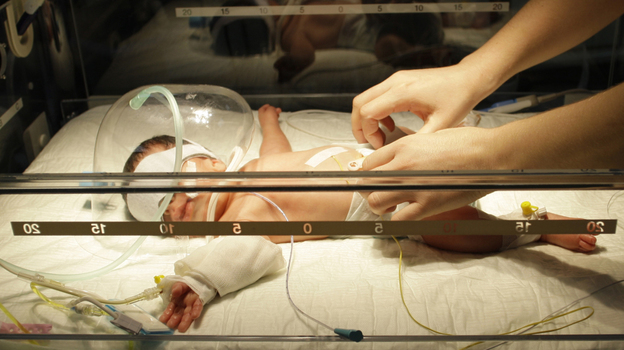
Why Brain Injuries Are More Common In Preemies


Why Brain Injuries Are More Common In Preemies


The most common cause of brain injury in premature infants is a lack of oxygen in the days and weeks after birth, researchers say.
Scientists say they are beginning to understand why brain injuries are so common in very premature infants — and they are coming up with strategies to prevent or repair these injuries.
The advances could eventually help reduce the number of premature babies who develop cerebral palsy, epilepsy or behavioral disorders such as ADHD, researchers told the Society for Neuroscience meeting in Washington, D.C., this week.
Each year more than 60,000 babies are born weighing less than 3.3 pounds. And because of advances in neonatal medicine over the past several decades, most of those babies will survive. But researchers have had less success finding ways to prevent brain damage in these infants.
"That means that overall rates of cerebral palsy and other neurodevelopmental disabilities are on the rise," says David Rowitch, chief of neonatology at the University of California, San Francisco.
The most common cause of brain injury in premature infants is a lack of oxygen in the days and weeks after birth, Rowitch says. The lack of oxygen damages white matter, which provides the "communication highways" that carry messages around the brain and to distant parts of the body, he says.
 
And the babies at greatest risk of this sort of brain damage are those born after as little as six months of gestation, Rowitch says.
"Such a baby would weigh about a pound and would fit into the palm of your hand," he says. "As you can imagine, they're very fragile and vulnerable to stresses."
Those stresses often include periods when an infant's immature lungs are not delivering enough oxygen to the brain, even with help from a mechanical breathing device.
This lack of oxygen appears to damage the most common type of white matter, myelin, which acts like an insulator around the nerve fibers that carry messages in the brain and nervous system. Without enough myelin, short circuits can prevent these messages from getting through, Rowitch says.
He initially found evidence of white matter damage by studying brains from premature infants who died. But since then, he's been able to assess premature infants using a special incubator designed to fit in an MRI scanner.
"We've been able to now take over 250 babies who are very preterm to the MRI scanner safely to show that this is a feasible way to detect white matter injury early on," he says.
Now the question is how to prevent or repair that sort of injury.
Some studies show that it's important to act right away, says Vittorio Gallo from Children's National Medical Center in Washington, D.C.
"There is a very critical developmental time window right after birth," Gallo says. "If development is disturbed during this critical time window then the brain doesn't catch up."
Gallo is part of a team of scientists who have shown that it is possible to intervene — at least in mice. One approach involves giving the mice a drug that speeds up production of myelin, he says.
"We do this intervention right after the injury," he says. "And we found that by targeting specific targets we can recover and regenerate at least part of these cells right after the injury, during that critical developmental time window."
Any drug for people is still years off, Gallo says
But other scientists at the meeting say there are promising treatments available now. These include everything from the magnetic stimulation of certain areas of the brain to temporarily lowering the body temperature of premature infants to protect brain tissue.


Full story here