Showing posts with label mouthpiece. Show all posts

Sunday, March 17, 2013

Concussions not preventable by safety equipment

Helmets and mouth-guards do little to prevent concussions, and this article discusses this and general information about concussions.

A global consensus report provides new guidance on diagnosing and treating concussions.
As concerns about concussions among football players continues to capture the attention of doctors as well as sports officials, an international team of researchers released an update to the Consensus Statement on Concussion in Sport.
It’s the fourth since the original report was developed in Vienna in 2001 to raise public awareness of the risks of concussions. Researchers and clinicians from around the globe presented the latest findings on brain injury and long term damage from concussions occurring during sports, over a two-day meeting held in Zurich, Switzerland last November. A panel of 32 experts then drafted the Consensus based on the research, published in the British Journal of Sports Medicine.
Written as a guide for athletic trainers, doctors and health care providers, the statement clarifies the definition of a concussion to emphasize that loss of consciousness isn’t necessary to remove players from a game; symptoms can include headaches, memory loss and slow reaction times, immediately after the trauma to the head. Later symptoms could also include irritability and sleep disturbances.
New advice in the Consensus states that children should not return to the field to play on the same day they experience a potential concussion, an acknowledgment that it may take longer for kids to recuperate from blows to the head than adults because their neural connections are still developing.
“Concussions are an evolving injury,” explains author Dr. Willem Meeuwisse, leader of the University of Calgary’s Brain Injury Initiative.”When you look at it from the moment it occurs to hours and even days later, it tends to change. That’s why, ‘when in doubt, sit them out,’ works.”
Additionally, the authors say there is a lack of evidence that mouth-guards and helmets prevent concussions. These pieces of equipment can protect against injuries to the head and face, but likely do little to ward off the more serious internal damage from a concussion. In fact, they may give players have a false sense of security and encourage them to behave more recklessly and aggressively. In the statement, the authors write:
An important consideration in the use of protective equipment is the concept of risk compensation. This is where the use of protective equipment results in behavioral  change such as the adoption of more dangerous playing techniques, which can result in a paradoxical increase in injury rates.
The researchers also added recommended against the blanket tendency for extended rest for people who have been concussed. “About 80% of people improve from rest after eight to ten days,” says Meeuwisse. “For those who are not better in ten days, they need a more thorough assessment and maybe therapy for neck problems or balance.”
For the first time, the Consensus also includes a guide for untrained individuals such as parents and coaches to recognize and help people who might be concussed as well as an assessment tool designed specifically for children that clinicians can use.
The report is backed by the International Ice Hockey Federation, the International Olympic Committee, FIFA (the international governing body for soccer), and the International Rugby Board, among a number of other international sports organizations.
Read more here

Monday, September 03, 2012

Football helmets and mouth guards cannot completely stop concussions

This article discusses how helmets and mouth guards can not guard against concussions. The only safe way to make sure a child does not get a concussion is if they do not play.

Before the football game between Navy and Army in 1893, Navy player Joseph Mason Reeves was advised by a doctor not to participate.
Another kick to the head could be fatal, the physician warned.
But Reeves was determined not to watch the game from the bench, so he hired a local shoemaker to fashion a leather hat for him to wear during the contest. And thus, according to legend at least, the first football helmet was invented.
More than a century later, helmets are not used only in football, but in other collision sports such as lacrosse and hockey. And even though the rudimentary headgear of the late 1800s has developed into the hard-shelled plastic helmets used today, modern head protection’s ability to prevent concussions is still questionable.
First, let’s get one thing straight: helmets (not only those of the football variety, but also hockey and lacrosse ones among others) do a great job of preventing most head injuries. Helmets were designed to keep the number of skull fractures at bay, and, in that regard, they have performed well. But helmets cannot keep the brain from shaking, rotating or twisting underneath the skull, and that is the cause of concussions.

Studies have shown, however, that the facemasks of hockey helmets can reduce the severity of concussions, and studies at Virginia Tech University show that some football helmets are better at preventing concussion-like symptoms than others.
Overall, though, football helmets cannot keep concussions from happening, particularly at the speed with which the game is played. According to the 2010 National Football League Concussion Report, of a total 167 concussions sustained in the 2010 regular season, just more than half (84) happened to the fastest players on the field: receivers, running backs and defensive backs.
Another piece of equipment aimed at reducing head injuries is the rubber mouth guard. The main way mouth guards are meant to protect from concussions is absorbing contact to the jaw and preventing the force of the contact from reaching the brain.
However, there still is no evidence suggesting that mouth guards perform this duty well.
Lastly, headgear for the non-collision sport of soccer is a controversial piece of equipment. Studies are still being done on the padded headbands, which the International Federation of Association Football (FIFA) first allowed in 2003. No concrete results have been settled on, and for now the effectiveness of soccer headgear is still unknown.
Head injuries, including concussions, have been prevalent in contact sports since the advent of those sports.
And although helmets, mouth guards and headbands are meant to reduce such injuries (and often do), concussions present an entirely different monster. Because concussions are unique injuries caused by violent motion of the brain, more research and development will be needed before any device can cut the number of concussions down to zero.
As it stands right now, there exists only one piece of equipment that can prevent concussions with 100 percent effectiveness: the bench.
Read more here

Thursday, August 23, 2012

Technology that can combat concussions


This article covers the newest and best technology to mitigate concussions, including helmets, mouth guards, and guardian caps.

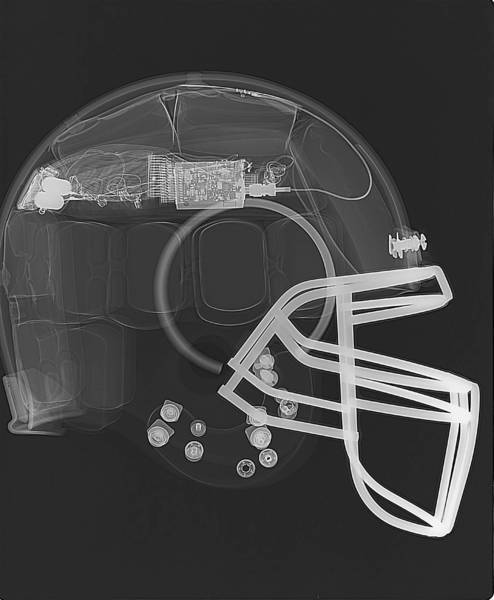
The drive to minimize head injuries in sports is stronger than ever, especially in football. The NFL, recognizing the importance, has put stricter player-safety rules and policies in place -- but technology is catching up to offer preventive methods to combat the issue. Below are three high-tech products being tested and used in all levels of football, from Pop Warner all the way to the NFL. It should be noted that these innovations do not prevent concussions, but rather reduce the risk of head injuries.

1. Xenith X2 football helmets

[+] Enlarge
Xenith helmets
Courtesy of XenithThe Xenith X2 is designed to minimize impact and head jolt in football collisions.
• The idea: While former Harvard quarterback Vin Ferrara was pursuing his medical degree from Columbia University, he decided to develop better helmets in early 2004 after being shaken by a clip of hockey player Eric Lindros lying on the ice after a concussion. Ferrara is now the founder of Xenith, a company that produces advanced helmet technology.

• The 360: Xenith helmets use patented technology to minimize impact and head jolt. The helmet conforms to the player's head, creating a custom fit without the need for an air pump or any other device. Notably, Xenith claims to be the only helmet manufacturer to use what the company has termed "Shock Bonnet." This technology puts an emphasis on shock absorbers, which adapt to each blow at every impact level.

You probably haven’t heard of Xenith, but that's mostly because helmet brands cannot advertise on the field. However, even though Riddell has a deal with the NFL that runs through 2013, athletes are free to use helmets of their choice. Notable Xenith X2 wearers include Buccaneers TE Dallas Clark, Patriots CB Devin McCourty and Ravens RB Ray Rice, with whom the company has recently announced a partnership deal. Says Ferrara: “As of this training camp, more than half of NFL teams have players wearing Xenith.”

• Worth noting: Sales of Xenith have risen exponentially: 24,000 helmets in 2010; 65,000 in 2011; and a projected 80,000 this year.

2. X2IMPACT mouth guards

[+] Enlarge
X2 Impact
Courtesy of X2X2 teamed with Microsoft to develop the mouthguard technology.
• The idea: In 2007, Rich Able’s son, then a high school junior, was knocked unconscious for nearly a minute playing football. It hit his father hard. But instead of just pulling his son from the sport, Able decided to do something about it, creating X2, a new company that focuses on head-impact monitoring technologies.

• The 360: X2 offers a high-tech mouth guard that monitors hits in real time. It is a custom-fit, standard boil-and-bite guard, but what makes it unique are the numerous embedded sensors that store data on the hits a player takes throughout the game. It can wirelessly send an alert to a trainer the moment a player is hit with high impact. An accompanying app allows the trainer to run the player through a series of tests to assess his/her condition. X2 has worked with Microsoft in developing the technology.

The mouth guards are at least a year from commercial release but X2 continues to expand its trials in various college programs. X2 is being used by a number of NCAA football teams, including Stanford, Notre Dame and the University of Washington. Stanford has expanded its use to women’s lacrosse and field hockey.

• Worth noting: UCLA head coach Jim Mora is an early investor in X2 and is chairman of the Sports Advisory Board.

3. Guardian Cap protective helmet covers

[+] Enlarge
Guardian Cap
Courtesy of POC VenturesGuardian Caps add less than one-third of a pound in helmet weight.
• The idea: A mother of five named Erin Hanson, seeing the need for better helmet technology for kids, created POC (Protecting Our Children) Ventures, which developed Guardian Caps.

• The 360: Guardian Caps are one-size-fits-all shells worn over helmets during practice. The waterproof, soft protector straps over a helmet and is designed to absorb helmet-to-helmet impact. Guardian has claimed the cap can reduce impact to the head up to 33 percent. Most helmets weigh 4 to 5 pounds; a Guardian Cap adds only .31 pounds of weight.

Each helmet cushion costs about $70 and lasts for up to two seasons. Currently, more than 200 teams, from youth through college programs, are using the Guardian shells. The company notes that, with 4,000 Guardians currently on the field, it has yet to hear reports of head or neck injuries sustained while wearing a Cap. Guardian hopes to expand its product for use in lacrosse and hockey.

Will we see Guardian Caps used in the NFL? Probably not anytime soon. At an NFL concussion symposium, Guardian Caps presented the Gladiator, a helmet with a fully integrated soft shell, for use in actual games. After review, the NFL determined that the product was too radical a change to incorporate into the league.

• Worth noting: Guardian Caps partnered with predecessor ProCap, which made custom helmets with extra cushioning. Former Buffalo Bill Mark Kelso sits on the Guardian Cap board and memorably wore a ProCap in the NFL from 1989 to 1993.

Read more here

Saturday, June 30, 2012

Devices help determine potential concussions on the field


For almost a decade, helmet-maker Riddell has gauged the frequency and severity of head impacts through helmets lined with sensors that communicate wirelessly to the sidelines. But Able "wanted to develop a technology that provided impact data for all sports, not just helmeted sports."
The result is the X2 Impact, an electronics-packed mouth guard that records direction, force and number of impacts to the head, then wirelessly sends the information to sideline staff. Able worked with engineer Christoph Mack and Seattle-based Anvil Studios to develop the "boil-and-bite" mouth guard, which has a gyroscope, accelerometer, radio and chipset inside to record and relay information.
Together with research partner Stanford University, whose football and women's soccer and field hockey teams are wearing the mouth guard, X2 is collecting data that it hopes will help coaches and medical professionals better determine when a concussion may have been suffered or at least when to pull an athlete off the field.
Neither monitoring system tells a trainer if a concussion has been suffered — unlike other injuries, a concussion isn't necessarily easy to see and instead is determined by symptoms that may (or may not) include nausea, dizziness, confusion, clumsiness and forgetfulness. Also, Able said, "so many times kids will hide their head injuries because they don't want to sit on the bench."
"We're an information and awareness tool," said Able, about X2. "We're giving information that helps a trained medical professional make a better assessment of a kid."
Some college trainers are immediately notified via pager with Riddell's system if an athlete has suffered an abnormally hard hit, so they can focus on that player.
Studies have shown that long-term exposure to concussion and blows to the head can result in Chronic Traumatic Encephalopathy, which can cause memory loss, confusion, impaired judgment, impulse-control problems, aggression, depression and eventually, progressive dementia, according to Boston University's Center for the Study of Traumatic Encephalopathy.
Game-changer
The mouth guard joins the nearly decade-old Head Impact Telemetry System and Sideline Response System, owned and co-developed by Riddell and product development firm Simbex. Data on 1.8 million on-field head impacts have been collected through the HITS system, leading to dozens of published studies and several rule changes, including:
Brown and Dartmouth successfully lobbied the Ivy League to eliminate in-season, full-contact practices and reduce them in preseason because of how many head impacts athletes were exposed to. "Reducing impact exposure will ultimately reduce athletes' risk of concussion," explained Thad Ide, Riddell's senior vice president of research and product development.
A study involving HITS data on 7- and 8-year-olds prompted several rule changes in Pop Warner Football this June: No full speed, head-on (face-to-face) blocking or tackling drills are allowed when players are more than 3 yards apart and, full contact will be reduced to a maximum of one-third of practice time. The study was conducted by Virginia Tech-Wake Forest University researchers.
The NFL moved the kickoff line up 5 yards to lower the number of collisions during kickoff returns, in part based on HITS data.
Virginia Tech uses the HITS system to rank football helmets by their concussion-reduction capabilities.
"Virginia Tech, UNC, Brown and Dartmouth, Indiana and Purdue — all of them use the (Riddell) system and study and pool their data," Ide said. "They're just scratching the surface of what they can learn from that data."
Coaches have used the system to change drills or plays that increase head-impact exposure. "If you have someone review the data regularly," added Ide, "you can look at the number and types of hits of a particular player and compare that to other players in that same position and skill level to determine if they're using their head improperly or too much.
"There's so much that's not known about concussion and impact exposure, so the research part is extremely important right now in order for us to make better choices in the long run."

For information on concussion and youth sports: cdc.gov/concussion/pdf/coaches_Engl.pdf
For how to recognize possible signs of concussion, go to cdc.gov/concussion/sports/recognize.html
Read more here

Monday, October 10, 2011

For study of concussions, Stanford athletes use high-tech mouthpiece to record head impact


The goal is to help medical scientists better understand what sorts of football collisions cause concussions, as well as whether there are any positions or particular plays associated with a greater risk of these traumatic brain injuries. The mouthpieces contain accelerometers and gyrometers that measure the linear and rotational force of head impacts.

Members of Stanford's football team, as well as women's field hockey and lacrosse teams, are testing this high-tech mouthpiece to measure the brain impacts of hits they receive while playing.

Stanford is the only university in the nation using the device to collect research data from collegeathletes.

“This study will build toward establishing clinically relevant head-impact correlations and thresholds to allow for a better understanding of the biomechanics of brain injuries,” said Dan Garza, MD, an assistant professor of orthopaedic surgery at the Stanford School of Medicine, who is leading the investigation. “It also will serve as a helpful tool to aid in the diagnosis and subsequent management of concussions.”

The researchers also plan to collect head-impact data from the Stanford women’s field hockey and lacrosse teams, whose members soon will be outfitted with the devices.

“It’s a great opportunity for our student athletes, many of whom conduct scientific research in their academic studies, to contribute to the leading-edge research being done in sports medicine here,” said Earl Koberlein, senior associate athletic director at Stanford. “It’s a good marriage of theuniversity’s strong academics and strong athletics.”

Read more: http://www.healthcanal.com/brain-nerves/21598-For-study-concussions-Stanford-athletes-use-high-tech-mouthpiece-record-head-impact.html