Showing posts with label long term effects of concussions. Show all posts

Monday, December 30, 2013

NIH and NFL will research long-term effects of concussions

This article outlines research that will be done on the long-term effects and consequences of concussions. This research will be done as a partnership between the National Institutes of Health (NIH) and the National Football League (NFL).

The U.S. National Institutes of Health is teaming up with the National Football League on research into the long-term effects of repeated head injuries and improving concussion diagnosis.
The projects will be supported largely through a $30 million donation made last year to the Foundation for the National Institutes of Health by the NFL, which is wrestling with the issue of concussions and their impact on current and former players.
There's growing concern about the potential long-term effects of repeated concussions, particularly among those most at risk, including football players and other athletes and members of the military.
Current tests can't reliably diagnosis concussion. And there's no way to predict which patients will recover quickly, suffer long-term symptoms or develop a progressive brain disease called chronic traumatic encephalopathy (CTE), according to an NIH press statement released Monday.
"We need to be able to predict which patterns of injury are rapidly reversible and which are not. This program will help researchers get closer to answering some of the important questions about concussion for our youth who play sports and their parents," Story Landis, director of the National Institute of Neurological Disorders and Stroke (NINDS), said in the news release.
Two of the projects will receive $6 million each and will focus on determining the extent of long-term changes that occur in the brain years after a head injury or after numerous concussions. They will involve researchers from NINDS, the National Institute of Child Health and Human Development and academic medical centers.
One of the projects will attempt to define a clear set of criteria for various stages of CTE. It will also seek to distinguish it from Alzheimer's disease, amyotrophic lateral sclerosis (Lou Gehrig's disease) and other degenerative brain diseases that as of now can only be determined in brain tissue samples collected after death. The objective is to find medical signs of CTE that might eventually be used to diagnose the illness in living people.
The other project will seek to identify the long-term effects of mild, moderate and severe traumatic brain injury (TBI) and compare them with features of CTE. The goal is to identify signs that could be used to diagnose brain degeneration linked to traumatic brain injury in patients.
While the two projects focus on different aspects of traumatic brain injury, "their combined results promise to answer critical questions about the chronic effects of single versus repetitive injuries on the brain, how repetitive TBI (traumatic brain injury) might lead to CTE, how commonly these changes occur in an adult population, and how CTE relates to neurodegenerative disorders like Alzheimer's disease," Landis said.
Six other pilot projects will receive a total of just over $2 million and last up to two years. They will concentrate on improving the diagnosis of concussions and identifying potential medical signs that can be used to assess a patient's recovery. If the early results are promising, these projects may form the basis of more extensive research, the news release said.

Tuesday, April 16, 2013

Study: Long-term effects of concussions tested by university student

University students in Georgia are leading an interesting study on the long-term effects of concussions.


From up in the stands on a Friday night, high school football spectators hear it — the grunt of an athlete, the whistle of a referee, the crack of a helmet against another helmet.
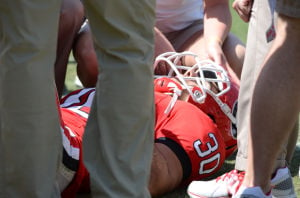
Down on the field, the player feels it. Every time he gets tackled to the ground, the player knocks his head against the inside of his helmet. Sometimes he’s fine, but, in less fortunate occasions, he sustains a concussion.
Doug Terry, a third-year Ph.D. student in clinical psychology, and others in the University of Georgia psychology department are studying the effects of those concussions in an experiment he said they hope to finish by the time August rolls around.
“This is a global health problem,” the Long Island, N.Y., native said. “The most common way to get a concussion is a sports-related injury. I’ve worked at Children’s Healthcare of Atlanta and now concussions are becoming an increasingly big concern. There’s almost panic in parents who have children — and children themselves, these days — related to if you get a concussion, what that’s going to mean later in life.”
Their research is based on a study released last fall by the National Institute for Occupational Safety and Health, which found that NFL players are at a higher risk of dying from complications with neurodegenerative diseases than the average population.
Concussions, Terry said, are a probable link to deaths caused by neurodegenerative diseases such as Alzheimer’s and amyotrophic lateral sclerosis.
“What we’re seeing in the NFL players is that they might have gotten a concussion and they recovered,” he said. “But then, 40 years later, they’re getting Alzheimer’s at higher rates or they have memory issues more so than people without concussions.”
So, in conjunction with Stephen Miller, a professor in the department of psychology and the director of the Bio-Imaging Research Center, Terry decided to test the NIOSH conditions in a way that would make the results less exclusive.
“How many concussions is too many?” Terry said. “That’s why I’m looking at a population that typically has fewer concussions than NFL players.”
He revamped his initial experiment so that there was a greater time lapse between sustaining a concussion and the after effects of the injury. This time, he wanted to test men in the age range of 40 to 65 who had, while playing football in high school (and not after), received a concussion.
The important part of the injury history, Terry said, is that the concussion had to be a result of playing football. Anyone who might have obtained a head injury in a car accident or a fall would not fit into the experiment because of the amount of force put on the brain.
“Picture yourself on a football field, getting tackled by somebody and hitting the ground and getting a concussion that way, versus going 50 miles an hour in a car and hitting a wall or another car,” he said. “In one, you’re getting whiplash. You’re going forward and then you’re going back in a car. That type of injury is different than if you’re getting tackled and your head just hits the floor and stops.”
The experiment
Last year, Terry tested the effects of concussions on UGA rugby players. The results were not surprising, he said.
“The guys were still in college, so they had had concussions and recovered from those concussions for at least six months,” he said. “We scanned them and did all of these different memory tasks. In that study, the young rugby players didn’t have any issues related to the concussions they had sustained.”
Miller, Terry’s mentor, said there is a possibility concussions at a young age can cause some cognitive changes that aren’t detected because of the injured person’s “top health.”
“If subtle damage or change occurred, over time it may have either an effect that can no longer be overcome by youth and high health, or an effect that worsens over time, to the point that 20 or more years later it begins to show up,” Miller said. “Of course, a third possibility is that having a series of concussions when you are young has no effect on you when in your 50s and 60s.”
To test those conclusions, Terry and company have combined memory tests and functional magnetic resonance imaging scans. The tasks include tests of working memory, which Terry said was the ability to concentrate on and do several things at once.
“When someone does a working memory task, their brain will use more resources,” he said. “After you get a concussion, your brain uses more oxygen, more neurons are firing and more glucose is used up by the brain. Your brain has to work harder to do the same thing. There’s evidence of that in functional MRI directly after a concussion.”
Patrick Curry, a second-year athletic training master’s student from Durham, Conn., is a UGA athletic trainer who has seen all the concussions sustained by University athletes in the last two years. He introduced Terry to a system, the “NeuroCom Balance Manager,” that can test the effects of concussions.
The benefits of using that machine in addition to the psychological tests Terry runs, Curry said, is that it has more capability than a general assessment.
“It’s an objective measure of balance that uses two force plates to measure your center pressure,” Curry said. “It tests all your systems of balance. It can see if balance is impaired many years after a concussion occurs.”
What Terry said he hopes to find in the experiment is the kind of effect, if any, a concussion has on an individual years after the injury.
Curry said the experiment’s results could have a major effect on the way teams handle concussions.
“The biggest thing we’re looking at right now and the biggest concern in sports medicine is the long term effects of concussions,” he said. “This experiment could be a great way to look at it. It could change how we manage concussions acutely. It could change our return to play criteria after someone sustains a concussion.”
Read more here