Wednesday, March 11, 2015

How to avoid issues from Daylight Savings Time

With Daylight Savings on March 8th, we will lose an hour of sleep. This article explains why it may be an issue for people and gives tips on how to avoid any problems.

You may find you feel a little more tired than usual next month as you adjust to the start of Daylight Saving Time, which begins at 2 a.m on Sunday, March 8.
“An hour seems like a minor change, but moving the clock ahead one hour can be very stressful or disruptive for some people, particularly for those who are already sleep deprived,” says to Jeffrey P. Barasch, M.D., FACCP, FAASM, Medical Director of The Valley Hospital Center for Sleep Medicine.
“The problem goes beyond just the loss of a single hour of sleep on the night of the clock change,” Dr. Barasch says, “The time change also plays havoc with the body’s circadian rhythm, or biological clock.”
This biological clock, located within a part of the brain behind the eyes, determines when we feel alert and when we are sleepy. The internal clock keeps our bodies synchronized with the daily light-dark cycle of the outside world. The biologic clock is ‘set’ or fixed to the time of day by two factors: the time we regularly wake up in the morning and our exposure to sunlight during the day. It can be reset, but (as anyone who has traveled by airplane across several time zones has experienced), the biological clock cannot be adjusted too quickly.

When we move the time clock one hour earlier for daylight savings time, our bodies remain partly on the prior schedule (known as ‘jetlag’ in plane travel). The result: 7 am in daylight savings time is equivalent to 6 a.m. standard time. Also, your typically sunlit mornings will now be dark, and that lack of morning light makes it even more difficult for your internal clock to adjust. So not only are we losing an hour of sleep, but since it can take some time to readjust, we’re left feeling tired for more than the one day on which the clocks change.

People who normally sleep well can usually adjust to the time shift with relatively little difficulty. However, if someone has been barely coping with an undiagnosed and untreated sleep disorder, daylight saving time can exacerbate and therefore unmask problems such as sleep apnea, insomnia or periodic limb movement disorder.

The following tips from Dr. Barasch can help you get a good night’s sleep:
• On the nights after the time change, go to bed at your usual time. You may experience some difficulty falling asleep, because your body’s clock has not yet adjusted.
• Get up at your usual time regularly. Although you may find this a bit difficult, it will help you adjust to the time change.
• Avoid sunlight or bright light in the first few evenings after the time change, as this will tend to keep you awake later and prevent adjustment of your body’s clock.
• Try to get sunlight exposure soon after awakening in the first few mornings after the time change, as this will help you adjust to the new time.
• A short nap can help make up for less sleep, but won’t help you acclimate to the new schedule. Don’t nap within a few hours of your regular bedtime to avoid disrupting nighttime sleep.
• Create a sleep-friendly environment that is dark, cool, comfortable and quiet.
• Have a relaxing routine before bedtime, such as soaking in a hot bath, reading or listening to soothing music.
• Avoid caffeine, nicotine and alcohol for several hours prior to bedtime, as they can disrupt sleep.

If you regularly experience daytime drowsiness, fatigue or disturbed sleep, speak to your doctor or consult with a sleep medicine specialist.

Read more here

Is my iPad disrupting my sleep?

This article explains how an iPad can disrupt a person's sleep.

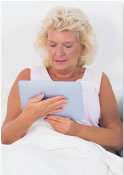
Using an iPad or other backlit electronic tablet in the hours before bedtime not only prevents you from falling asleep, it may also affect your alertness the next day, according to a report published in the Proceedings of the National Academy of Sciences, Dec. 22, 2014. Researchers at Harvard-affiliated Brigham and Women’s Hospital found that the light emitted by the devices reset the body’s circadian clock, which synchronizes the daily rhythm of sleep to daylight. As a result, people reading e-books took longer to fall asleep and were less alert the next morning than when they read print books instead.

During the two-week study, 12 men and women read digital books on an iPad for four hours before bedtime each night for five consecutive nights. They also followed the same routine using printed books. When they read the iPad, participants were less sleepy before bedtime but were less alert the following morning, even after eight hours of sleep.

If you’re a bedtime reader who’s addicted to her iPad, don’t despair. The researchers used a 2010
iPad set at maximum brightness. Newer iPads and other e-readers have night-reading modes.

Read more here

Concussion risk not lowered by helmet add-ons

A study on helmet add-ons indicated that the add-ons may not reduce the risk of having a concussion. 


While the sporting industry continues to cash in on equipment that promises to reduce the risk of player injury, a new study on helmet add-ons suggests that the buyer should beware.
The study conducted by Florida’s BRAINS Inc. and presented at the American Academy of Neurology, tested four different sporting technologies targeting football helmets that are sold on the premise of reducing head injuries.
A concussion, a type of traumatic brain injury (TBI), can be caused by a bump, blow or jolt to the head, or by a blow to the body that causes the head and brain to move rapidly back and forth, according to the Centers for Disease Control and Prevention (CDC). The sudden movement can cause the brain to bounce around or twist in the skull, stretching and damaging brain cells which may create chemical changes in the brain.
Researchers used a crash test dummy head and neck to simulate head impact by modifying the standard drop test system approved by the National Operating Committee on Standards for Athletic Equipment. Sensors were placed in the dummy’s head to measure linear and angular rotational responses to helmet impacts at 10, 12 and 14 miles per hour.
They then evaluated four football helmet add-ons currently on the market: Guardian Cap, UnEqual Technologies’ Concussion Reduction Technology, Shockstrips and Helmet Glide. Each technology was placed on the Riddell Revolution Speed and Xenith X1 football helmet and impacted five times from drop heights of 1.0, 1.5 and 2.0 meters.
Researchers found that while the helmet add-ons reduced linear acceleration impact by about 11 percent, they only reduced angular acceleration impact by 2 percent. The Helmet Glide was even shown to have no effect on either.
“Currently helmets and helmet add-ons are only designed to reduce the linear acceleration, not the angular acceleration. The linear acceleration is responsible for the contusion injuries on the brain, skull fractures and bruising on the head. Angular accelerations are the forces associated with concussions,” study author Dr. John Llyod, the research director at BRAINS Inc. and board certified ergonomist and brain injury specialist in Florida, told FoxNews.com. 
The researchers noted that manufactures do not test the angular metric of injury prevention-based sporting equipment, but also that the add-ons do not have any negative affect on a player.
“The main issue with the add-ons is if you as a parent or even as an individual walk into Sports Authority or Dick’s Sporting, you ask ‘What are these for?’ and [salesmen] are going to say ‘They’re for preventing concussions,’” study co-author Dr. Francis Conidi, assistant professor of neurology at Florida State University College of Medicine and concussion specialist told FoxNews.com.
“First and most importantly, their intent is to market them to prevent concussions and they’re not training the individuals selling the devices. The parents are getting a false sense of safety, while the results show they offer little to no protection of concussion,” Conidi said.
Conidi explained that a concussion is more-so a whiplash-type injury than a straight-on impact, which is what the linear testing measures.
“If I hit you straight on with a baseball bat, I would not induce concussion,” he said. “I would probably fracture your skull, but I would not concuss it.”
“It’s really the angular and rotational mechanism of the skull that causes the tearing of brain cells, which causes the ion cells to leak out,” Conidi said.
The researchers conclude that because there is no device on the market right now that adequately protects an athlete against a concussion, athletes must be taught proper tackling techniques from an early age.
Conidi, who has treated numerous athletes of all levels for concussions, suggested working with the athlete to strengthen the cervical muscles so the head doesn’t bend to the side or rotate as easily.
“Most importantly, be educated on the signs and symptoms, especially the athletes themselves, and the parents and coaches. When in doubt, sit them out,” he said.
Currently, an estimated 173,285 sports and recreation-related TBIs are treated among children and adolescents in the U.S. each year. According to the CDC, for males aged 10-19 years, sports-and recreation-related TBIs occurred most often while playing football or bicycling.
The study’s authors hope their findings will lead to more rigorous testing of helmets and add-ons.
Read more here

Monday, March 09, 2015

Seizure Monitors Movement Monitors Reviewed - Send Your Comments!

I have patients using all these monitors....Sadly neurologists don't get to trial these devices...What do you think? - JR


Smart Monitor -  About the SmartWatch
SmartWatch is an easy-to-use, non-invasive wristwatch that continuously monitors movements and instantly alerts connected family members and caregivers upon the onset of repetitive, irregular shaking motion.
http://www.smart-monitor.com/


SAMi™ is a sleep activity monitor for anyone (caregivers and individuals) who needs to watch carefully for unusual movements at night. 

http://www.samialert.com/


Emfit monitors - 

Emfit Movement Monitor / USA and Canada

The Emfit Movement Monitor is the latest technology for monitoring an individual who, during sleep, may experience certain types of movements which a caregiver or family member should be alerted to. The Emfit Movement Monitor is ideal for monitoring and detecting abnormal movements such as muscle spasms associated with a sleeping person
http://www.emfit.com/en/care/products_care/movement-monitor/


Seizure Tracker for iPhone


Seizure Log

By Seizure Tracker LLC


View More by This Developer

A useful app for tracking seizures!
Android or IPhone
JR


OSeizure Log

By Seizure Tracker LLC

View More by This Developer

Open iTunes to buy and download apps.

Description

Logging seizures and keeping good records is an essential skill for managing epilepsy and it has never been easier!

Renowned website, SeizureTracker.com is excited to bring you an entirely new way to log seizures that builds on the Seizure Tracker experience. App users can time and videotape seizures simultaneously in this revolutionary and simple-to-use application. When you stop the video and timer, it immediately creates an event log that is stored in a seizure library. You can edit the event at any time to add additional details about triggers, seizure description and what happened afterward. You can also use this app to log seizures without videos attached.

Videos recorded through this app can be synchronized to a YouTube account which allows them to be shared privately outside the app. Full reporting capabilities are available through SeizureTracker.com.

Seizure Tracker was founded by the parents of a child with Epilepsy. We were searching for solutions to ease our own situation and in the process found a way to give back to the community and help others too. Our goal is to empower people living with Epilepsy while redefining the way information about seizures and Epilepsy is collected and shared.

Key Features
- Time and visually record seizures as they happen
- Videotape seizures and upload them to YouTube for private sharing
- Record VNS Usages and Rescue Medication administrations
- Automatically add recorded seizure to Library
- Add additional information to seizure entries
- Create seizure entries with manual entry tool
- Store information in Seizure Library
- Synchronize events with SeizureTracker.com account
- Graph synchronized events (and surrounding information) through the integrated Seizure Tracker system.

Please email Info@SeizureTracker.com with comments and suggestions.

Note: 
-If you are receiving "com.google.GDataServiceDomain error 403" when attempting to upload a video please re-enter your YouTube user name and password in the device settings area. 

Special thanks to Element 84 for developing this app.

...More
Seizure Tracker LLC Web SiteSeizure Log Support
What's New in Version 2.1
+ Adds alert sounds to Rescue Medication and VNS timers during Event capture
+ Alerts are configurable in settings under both Rescue Medication and VNS
+ VNS data collection and magnet usage enhancementsts are configurable in settings under both Rescue Medication and VNS
+ VNS data collection and magnet usage enhancements

Thursday, March 05, 2015

Stuff to buy for your child/toddler with gross motor delay.


The Learning Tower http://www.littlepartners.com/

Dump The Stroller - The Fire Engine - http://p2.la-img.com/1265/57327/28083187_1_l.jpg

The pediatric neuro-genetics revolution is here....But ...what can the exome not do?

Does your child have an unknown? The exome is here to stay! 

But...here is what the exome cant do....  JR

10 Things Exome Sequencing Can’t Do–but Why It’s Still Powerful

The views expressed are those of the author and are not necessarily those of Scientific American.


Sequencing of the exome – the protein-encoding parts of all the genes – is beginning to dominate the genetics journals as well as headlines, thanks to its ability to diagnose the formerly undiagnosable.
The 2011 Pulitzer Prize in Explanatory Reportinghonored the Milwaukee-Wisconsin Journal Sentinel’s coverage of a 4-year-old whose intestinal disorder was finally diagnosed after sequencing his exome. Once investigators assigned a gene to his symptoms, a bone marrow transplant saved his life. And a just-published study compared the exomes of 12 children with combinations of developmental delay, intellectual disability, and birth defects at the Duke University genetics clinic to reference exomes, revealing 7 mutations, 2 in genes not known to be associated with disease.
In the best-case scenario, mutations revealed by exome sequencing suggest a treatment, as it did for the 4-year-old. But that may be unusual. “We can’t treat most of the Mendelian diseases we know about, so we won’t be able in the near and medium term to treat most of the cases that are diagnosed by sequencing,“ says David Goldstein, PhD, director of the center for human genome variation at Duke and an author of the study. The new National Center for Advancing Translational Sciencesmay add to existing treatments and new drug discovery by providing access to compounds from three major pharmaceutical companies. One study’s reject could be another’s cure.
But for certain types of genetic disorders, exome sequencing won’t help. Understanding what, exactly, an exome is reveals why.
A little less than 2% of the 3.2 billion bases of a human genome encode protein. Most genes consist of sections that are transcribed (into RNA) and translated into protein — these are exons – and sections that are transcribed but are then snipped out before the protein forms – these are introns. The exome, including only exons, is to the genome what a Wikipedia entry about a book is to the actual book. It’s part of the story, albeit an important part.
Admission: Back in the Precambrian period when I was in high school, I read the CliffsNotes version of John Steinbeck’s “The Grapes of Wrath.” I read the actual book many years later, and what a difference! The meager plot summary I read in high school missed the nuances, the connections, the feel and the utter devastation of the final scene.
Analyzing an exome to understand a disease is, in some cases, like reading the CliffsNotes version of a classic book.

The 10 Exceptions

Understanding the limitations of exome sequencing is important because it’s already here. “Be one of the first to get your personal exome sequence,” proclaims 23andMe, about its pilot Exome80x project, offered direct-to-consumer, “for research and educational use only.”'

The first CLIA-certified test, Clinical Diagnostic ExomeTM, became available fromAmbry Genetics earlier this year. A news release announcing the diagnosis of three tough cases calls the technology “essentially a human genome project for an individual patient.” Said CEO Charles Dunlop, “Some of these families have been trying to figure out what was ailing their children for years, and we solved the riddle in weeks.”

But exome sequencing won’t help every family, and here’s my list of reasons why. The technology won’t detect:

1. Genes in all exons. A few exons, such as those buried in stretches of repeats out towards the chromosome tips, aren’t part of exome sequencing chips.

2. Mutations in the handful of genes that reside in mitochondria, rather than in the nucleus.

3. “Structural variants,” such as translocations and inversions, that move or flip DNA but don’t alter the base sequence (detectable other ways).

4. Triplet repeat disorders, such as Huntington’s disease and fragile X syndrome. Their mutations don’t change the DNA base sequence – they expand what’s already there.
5. Other copy number variants will remain beneath the radar, for they too don’t change the sequence, but can increase disease risk.

6. Genes in introns. A mutation that jettisons a base in an intron can have dire consequences: inserting intron sequences into the protein, or obliterating the careful stitching together of exons, dropping gene sections. For example, a mutation in the apoE4 gene, associated with Alzheimer’s disease risk, puts part of an intron into the protein.

7. “Uniparental disomy.” Two mutations from one parent, rather than one from each, appear the same in an exome screen: the kid has two mutations. But whether mutations come from only mom, only dad, or one from each has different consequences for risk to future siblings. In fact, a case of UPD reported in 1988 led to discovery of the cystic fibrosis gene.

8. Control sequences. Much of the human genome tells the exome what to do, like a gigantic instruction manual for a tiny but vital device. For example, mutations in microRNAs cause cancer by silencing various genes, but the DNA that encodes about half of the 1,000 or so microRNAs is intronic – and therefore not on exome chips.

9. Gene-gene (epistatic) interactions. One gene affecting the expression of another can explain why siblings with the same single-gene disease suffer to a different extent. For example, a child with severe spinal muscular atrophy, in which an abnormal protein shortens axons of motor neurons, may have a brother who also inherits SMA but has a milder case thanks to a variant of a second gene that extends axons. Computational tools will need to sort out networks of interacting genes revealed in exome sequencing.

10. Epigenetic changes. Environmental factors can place shielding methyl groups directly onto DNA, blocking expression of certain genes. Starvation during the “Dutch Hunger Winter” of 1945, for example, is associated with schizophrenia in those who were fetuses at the time, due to methylation of certain genes. Exome sequencing picks up DNA sequences – not gene expression.

3 Great Uses for Exome Sequencing

Exome sequencing is of great value in two obvious situations: (a) finding a mutation in a known gene behind an “atypical presentation,” such as Nicholas Volker, the saved Pulitzer boy; and (b), identifying mutations in novel genes, like 2 of the 7 children in the Duke University clinic.

Another application is subtle: exome sequencing reveals incomplete penetrance, a phenomenon in which a person gets lucky. He or she has mutations that should cause a particular trait or illness, but they don’t.

Exome sequencing of parent-child trios can reveal when an apparently healthy parent actually has the same mutation as the sick child, but for some reason escaped the genetic fate. A genetic counselor would use this information in predicting risk for siblings. If mom or dad contributes a mutation, the next kid faces a much higher risk than if the affected child has a new mutation. But there’s a bigger picture. Figuring out how the parent stays healthy can reveal new drug targets, and perhaps even lead to repurposing an existing treatment.