Information, News & Discussion about Infant Pediatric & Adolescent Neurology & Sleep Disorders. Science Diagnostics Symptoms Treatment. Topics include: Seizures Epilepsy Spasticity Developmental Disorders Cerebral Palsy Headaches Tics Concussion Brain Injury Neurobehavioral Disorders ADHD Autism Serving Texas Children's Neurology, Epilepsy, Developmental & Sleep Problems in The Houston Area and The San Antonio / Central & South Texas Areas
Tuesday, December 23, 2014
What is microchimerism? Scientists Discover Children’s Cells Living in Mothers’ Brains
Thursday, June 13, 2013
Sleep disorders in children can hurt their development
Monday, October 08, 2012
Non-Verbal Baby Communication Gives Clues to Autism
Approximately 19 percent of children with a sibling diagnosed with Autism Spectrum Disorder (ASD) will develop Autism due to shared genetic and environmental vulnerabilities, according to previous studies. For that reason, University of Miami (UM) psychologists are developing ways to predict the occurrence of ASD in high-risk children, early in life, in hopes that early intervention will lead to better outcomes in the future. Their findings are published in the journalInfancy.
- Initiating Joint Attention (IJA) -- the way an infant shows interest in an object or event to a partner. For example, making eye contact and pointing to show a toy.
- Initiating Behavioral Requests (IBR)-the manner in which an infant requests help from a partner, by making eye contact to request a toy, reaching toward, pointing to, or giving the examiner a desired toy.
- Responding to Joint Attention (RJA)-the way infants respond and follow the behavior of a partner. For example, when the examiner points to something and the child follows the experimenter's gaze to look at that an object. The results show that lower levels of IJA and IBR growth between eight and 18 months predicted the severity of ASD symptoms for children that had a sibling with Autism.
Tuesday, September 11, 2012
Anxiety in adolescents born preterm or with very low birthweight: a meta-analysis of case–control studies
Method We used a systematic review and meta-analysis. We searched the databases ISI Web of Knowledge, PubMed, PsycNET, Educational Resources Information Center (ERIC), Latin American and Caribbean Literature on the Health Sciences (LILACS), and Virtual Health Library (VHL) with equivalent search expressions (from the databases’ inception to June 2011). Also, we screened reference lists of identified articles. We selected case–control studies of adolescents 11 to 20 years old who were very preterm/VLBW and had a matched reference group born at term with normal birthweight that reported a validated anxiety outcome measure. For data extraction, two authors independently reviewed titles, abstracts, and full articles identified through the searches. Subsequently two authors independently extracted data.
Sunday, May 20, 2012
Baby's head and neck control may be an autism clue
Early research suggests that if a 6-month old baby has "head lag," or weak head and neck control, it may be an early sign of autism or another language/social developmental delay.
The test is simple – babies who are lying on the floor are pulled up into a sitting position. If the baby's head is not moving forward as you pull the baby up, it's a sign of weak head and neck control.
Researchers already know that head lag could be an early sign that a child's nervous system is not developing correctly. They've seen this in children with cerebral palsy and preterm infants, for example. But so far it had not been documented in children with autism.
Researchers at Baltimore's Kennedy Krieger Institute looked at a small sample of babies who were already at high risk for autism because they had a sibling with autism. If a couple already has one child with an autism spectrum disorder there's a nearly 1 in 5 chance that the second child will have autism too. According to the latest CDC estimates , 1 in 88 children in the United States has an autism diagnosis. It's 5 times more common in boys than girls.
A group of 40 babies were tested at 6 months. Ten children were later diagnosed with ASD at the age of 3. Nine of those 10 babies had head lag when they were 6 months old.
More than half of the children (54%) who were later diagnosed with language or social developmental delays but not autism also had head lag at 6 months, says Rebecca Landa, one of the study authors and the director of the Center for Autism and Related Disorders at Kennedy Krieger.
In a second study that compared 20 high risk babies to 21 low-risk babies, 75% in the high risk category showed signs of head lag at six months compared to only 33% in the low-risk group.
Landa acknowledges that this research, presented Thursday at a meeting of the International Society for Autism Research in Toronto, is very preliminary and needs to be confirmed in larger studies.
She also cautions that weak head and neck control doesn't automatically mean your baby will develop autism. But, Landa says, if you already have a child with autism and your baby is showing this kind of problem, you should take the child to see a specialist.
"If you don't have a family history of autism, and your child had head lag at 6 months - it might be something else, or might be nothing, but it's important to check it out," she says.
The goal is to identify a child with autism as early as possible so therapy can start early.
"We don't want to wait until children are 1 or 2 when they are more likely to show symptoms of autism."
Alycia Halladay, director of research for environmental sciences at the advocacy group Autism Speaks, says this is a very important study and deserves replication. She says it's too early to consider head lag a diagnostic marker, it's one of many red flags that parents may notice very early in development and something a doctor can easily check out.
Halladay, who was not involved in the research, says "this provides something that parents can bring to their doctors beyond just a concern."
Landa says she doesn't want to scare every parent into thinking their child may have autism because their little one has poor postural control, especially because in some children the problem goes away.
However, this is a simple test that doesn't cost anything, doesn't hurt a child, and - if a child were referred to therapy - doesn't hurt a child but can enrich their development, with or without a subsequent autism diagnosis.
Landa says parents can easily be trained to help their baby improve head and neck control. She suggests Googling "tummy time," which can lead parents to a lot of good information on fun and supportive tummy time exercises to help build their baby's neck muscles.
She also suggests sitting babies up, holding babies at the hips and slowly rocking them from side to side - just enough so that the baby leans to the center, which she says activates the core muscles so the baby stays balanced. Babies love it, especially if you sing a song while doing this.
Read more here
Wednesday, May 09, 2012
Prepregnancy Obesity Linked to Child's Cognitive Function
Women who are obese before they become pregnant are at higher risk of having children with lower cognitive function -- as measured by math and reading tests taken between ages 5 to 7 years -- than are mothers with a healthy prepregnancy weight, new research suggests.
In this large observational study, prepregnancy obesity was associated, on average, with a three-point drop in reading scores and a two-point reduction in math scores on a commonly used test of children's cognitive function.
Previous research has suggested that a woman's prepregnancy obesity can have a negative effect on fetal organs, such as the heart, liver and pancreas. Because fetal development is rapid and sensitive to a mother's physiological characteristics, Ohio State University researchers sought to find out whether a mother's obesity also could affect the fetal brain.
"One way you measure the effects on the brain is by measuring cognition," said Rika Tanda, lead author of the study and a doctoral candidate in nursing at Ohio State.
The research also supported findings in previous studies suggesting that several other conditions affect childhood cognition, including how stimulating the home environment is, family income and a mother's education and cognitive skills.
"The new piece here is we have a measure associated with the fetus's environment to add to that set of potential risk factors," said Pamela Salsberry, senior author of the study and a professor of nursing at Ohio State. "If we have a good way to understand the risks each child is born with, we could tailor the post-birth environment in such a way that they could reach their maximum capabilities."
The research appears online and is scheduled for future print publication in the Maternal and Child Health Journal.
The researchers used data from the National Longitudinal Survey of Youth (NLSY) 1979 Mother and Child Survey, a nationally representative sample of men and women who were 14-21 years old in December 1978. From that dataset, Tanda collected information on 3,412 children born to NLSY mothers who had been full-term births, were between 5 and almost 7 years old at the time of their interview and who had no diagnosed physical or cognition problems.
In addition to documenting a number of characteristics about the mothers and the family environment, the researchers gauged the children's cognitive function based on their performance on Peabody Individual Achievement Test reading recognition and math assessments.
The researchers calculated the mothers' body mass index (BMI) based on their reported heights and weights. More than half of mothers had normal BMIs before pregnancy, and 9.6 percent were obese, meaning they had a BMI of 30 or higher.
Controlling for all other variables, the analysis showed that maternal prepregnancy obesity was negatively associated with math and reading test scores. Children of obese women scored, on average, three points lower on reading and two points lower on math than did children of healthy-weight women. The mean reading score among all the children was 106.1 points and the mean math score was 99.9.
Though the score differences seem small, Tanda noted that these effects of prepregnancy obesity were equivalent to a seven-year decrease in the mothers' education and significantly lower family income, two other known risk factors that negatively affect childhood cognitive function.
Tanda said clinicians could use these findings to help encourage women patients of childbearing age to maintain a healthy weight, especially if they plan to get pregnant.
"This is a large population study, so at the individual level we can't say that one person's decision to change her weight will change her child's outcome," she said. "But these findings suggest that children born to women who are obese before pregnancy might need extra support."
Added Salsberry, "It's not only for their child's sake. It's also important for the health of the mother. But it is important to understand that maternal obesity during pregnancy could have implications for their children as well."
Without actual measures of women's and fetuses' insulin levels, inflammation and blood sugar readings, scientists can't say for sure how prepregnancy obesity might affect the fetal brain. But previous studies have suggested that a mother's impaired metabolic processes affect the fetal brain cell growth and formation of synapses.
The researchers also noted that obesity doesn't automatically equate to unhealthy.
"There may be two obese moms that in fact have very different metabolic profiles. For the purposes of this study, her weight is a stand-in for biological data that we would like to have but don't," Salsberry said.
Socioeconomic data from the study supported previous findings that several post-birth conditions can have a positive association with higher children's test scores. These include a stimulating home environment with plenty of books, a safe play environment and frequent family meals; higher family income; and higher maternal education levels and cognitive function. Girls and first-born children also performed better on the math and reading tests than did boys and younger siblings.
With all these data combined, Tanda said, the study also reveals how health disparities can have long-lasting effects.
"Young females who grow up poor, who have less access to healthy foods resulting in diets that are of poorer quality, are at higher risk of having children with disadvantages and repeating this cycle," she said.
The researchers are continuing to examine additional influences on childhood cognition, including race, sex and age differences among mothers.
Read more here
Wednesday, April 18, 2012
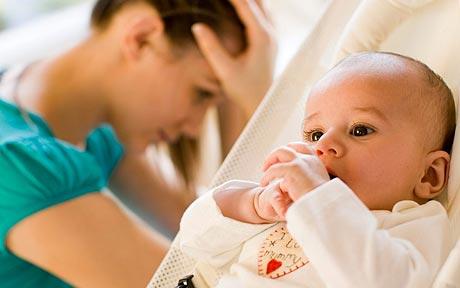
Study Claims Depressed Moms Disturb Their Babies' Sleep
A mother's depression may affect her baby's sleep, a new study suggests.
The results show depressed mothers are more likely to needlessly wake up their infants at night than mothers who are not depressed, the researchers said.
"When depressed mothers sought out their infants at night, their infants did not appear to be in need of parental help. They were either sound asleep or perhaps awake, but not distressed," said study researcher Douglas Teti, professor of human development, psychology, and pediatrics at the Pennsylvania State University.
Depressed mothers who worry excessively about their babies' well-being at night may respond to infant sounds that don't necessarily require response, or move their babies into their own beds to alleviate their own anxieties about whether their infants are hungry, thirsty and comfortable, the researchers said. Mothers who are feeling depressed also may seek out their infants at night for their own emotional comfort, they said.
"Sleep problems often endure beyond early childhood, and can have a negative effect on various aspects of development, including emotional, behavioral, and academic functioning," Teti said. "Understanding how maternal depression and sleep problems combine to affect children's development is important to developing interventions to help reduce these negative consequences."
Teti and colleagues collected data on 45 infants, ages 1 month to 2 years old, and their parents over seven consecutive days. The mothers kept a diary of their infants' sleeping habits, and they also completed a survey to assess their depressive symptoms and worries about their infants.
On the sixth day of the study, the researchers set up video cameras around each baby's bed, and other rooms in the house where mothers took their babies during the night. The cameras captured between 10 and 12 hours of video. What the researchers observed on the videos agreed with what the parents reported.
Mothers with higher levels of depression and more worries about their children's sleep had children whose sleep was more disrupted.
Previous studies had found a link between depression in moms and disturbed sleep in babies, and some researchers had suggested that infants' who slept poorly could affect their mothers' mental health. But the new study shows that it was most likely the mothers' behavior, and not the infants, that played the larger role in the link, the researchers said.
Moms with more symptoms of depression and worries behaved in ways that disrupted their infants' sleep — for example, picking up babies who were sleeping.
If parental depression or worry disrupts both a parent's and an infant's sleep, it could have negative consequences for the parent-child relationship over the long term. In situations like these, steps might be considered to help reduce parents' distress, the researchers wrote in the April 17 issue of the journal Child Development.
Read more here
Thursday, April 12, 2012
Left Hand – Right Hand, Premature Babies Make the Link
Recognizing that an object already manipulated with one hand is the same as that held in the other hand is an important ability of the brain known as "intermanual transfer." This activity reflects the brain's capacity to memorize information on an object, store it as memory and compare it with information taken in by the opposite hand. Medical imaging has shown that the transfer of information relies on the integrity of the posterior part of the corpus callosum. Composed of a series of neural fibers, this bundle connects the two hemispheres of the brain and thus ensures the coordination of information. Due to its very slow maturation, it is the final brain structure to develop in fetuses. The question is therefore to determine at what point it becomes functional....
article here