Showing posts with label dyslexia. Show all posts

Monday, August 19, 2019

TransCranial Electrical Stimulation - tDCS tACS - What is it?

What is Transcranial Electrical Stimulation? TES


Transcranial Direct Current Stimulation (tDCS)?

Transcranial direct current stimulation (tDCS), is a non-invasive, painless brain stimulation treatment that uses direct electrical currents to stimulate specific parts of the brain.


The therapy works by delivering a low-intensity electrical current to the part of the brain responsible for abnormal pain sensation. This constant, low-intensity current is passed through two electrodes placed over the head which modulates neuronal activity.
The treatment is not surgical and drug-free. 
There are two types of stimulation with tDCS: anodal and cathodal stimulation. Anodal stimulation acts to excite neuronal activity while cathodal stimulation inhibits or reduces neuronal activity.

Is Transcranial Direct Current Stimulation (tDCS) Effective?

Recent studies support the therapeutic potential of tDCS in patients with:
  • Ataxia
  • ADHD
  • Autism
  • Epilepsy
  • COVID - Related Fatigue
  • Fibromyalgia
  • Brain injury
  • Tinnitus (ringing in the ears)
  • Disorders of Consciousness
  • Dyslexia
  • Spasticity
  • Cerebral Palsy
In adults, it has been used for Parkinson’s disease, stroke recovery, traumatic spinal cord injury, depression, and other illnesses.
Similar but different therapies include:  TACS (alternating current)
TES treatments are complementary - that is, they are used after standard therapies have failed.
We use an FDA-approved device for this off-label use.  tDCS devices have not been approved by the FDA for this application.
Although tDCS is still an evolving form of brain stimulation, it has several advantages over other brain stimulation techniques. 
It is economical, non-invasive, minimally uncomfortable, and safe.
Call our office to learn more.


Sunday, September 08, 2013

Dyslexia diagnosed by brain scans? Examine the arcuate fasciculus

Brain scans showing the brain's structure may soon be able to show a person is dyslexic. JR

About 10 percent of the U.S. population suffers from dyslexia, a condition that makes learning to read difficult. Dyslexia is usually diagnosed around second grade, but the results of a new study from MIT could help identify those children before they even begin reading, so they can be given extra help earlier.
The study, done with researchers at Boston Children's Hospital, found a correlation between poor pre-reading skills in kindergartners and the size of a brain structure that connects two language-processing areas.
Previous studies have shown that in adults with poor reading skills, this structure, known as the arcuate fasciculus, is smaller and less organized than in adults who read normally. However, it was unknown if these differences cause reading difficulties or result from lack of reading experience.
"We were very interested in looking at children prior to reading instruction and whether you would see these kinds of differences," says John Gabrieli, the Grover M. Hermann Professor of Health Sciences and Technology, professor of brain and cognitive sciences and a member of MIT's McGovern Institute for Brain Research.
Gabrieli and Nadine Gaab, an assistant professor of pediatrics at Boston Children's Hospital, are the senior authors of a paper describing the results in the Aug. 14 issue of theJournal of Neuroscience. Lead authors of the paper are MIT postdocs Zeynep Saygin and Elizabeth Norton.
The path to reading
The new study is part of a larger effort involving approximately 1,000 children at schools throughout Massachusetts and Rhode Island. At the beginning of kindergarten, children whose parents give permission to participate are assessed for pre-reading skills, such as being able to put words together from sounds.
"From that, we're able to provide -- at the beginning of kindergarten -- a snapshot of how that child's pre-reading abilities look relative to others in their classroom or other peers, which is a real benefit to the child's parents and teachers," Norton says.
The researchers then invite a subset of the children to come to MIT for brain imaging. The Journal of Neuroscience study included 40 children who had their brains scanned using a technique known as diffusion-weighted imaging, which is based on magnetic resonance imaging (MRI).
This type of imaging reveals the size and organization of the brain's white matter -- bundles of nerves that carry information between brain regions. The researchers focused on three white-matter tracts associated with reading skill, all located on the left side of the brain: the arcuate fasciculus, the inferior longitudinal fasciculus (ILF) and the superior longitudinal fasciculus (SLF).
When comparing the brain scans and the results of several different types of pre-reading tests, the researchers found a correlation between the size and organization of the arcuate fasciculus and performance on tests of phonological awareness -- the ability to identify and manipulate the sounds of language.
Phonological awareness can be measured by testing how well children can segment sounds, identify them in isolation, and rearrange them to make new words. Strong phonological skills have previously been linked with ease of learning to read. "The first step in reading is to match the printed letters with the sounds of letters that you know exist in the world," Norton says.
The researchers also tested the children on two other skills that have been shown to predict reading ability -- rapid naming, which is the ability to name a series of familiar objects as quickly as you can, and the ability to name letters. They did not find any correlation between these skills and the size or organization of the white-matter structures scanned in this study.
Brian Wandell, director of Stanford University's Center for Cognitive and Neurobiological Imaging, says the study is a valuable contribution to efforts to find biological markers that a child is likely to need extra help to learn to read.
"The work identifies a clear marker that predicts reading, and the marker is present at a very young age. Their results raise questions about the biological basis of the marker and provides scientists with excellent new targets for study," says Wandell, who was not part of the research team.
Early intervention
The left arcuate fasciculus connects Broca's area, which is involved in speech production, and Wernicke's area, which is involved in understanding written and spoken language. A larger and more organized arcuate fasciculus could aid in communication between those two regions, the researchers say.
Gabrieli points out that the structural differences found in the study don't necessarily reflect genetic differences; environmental influences could also be involved. "At the moment when the children arrive at kindergarten, which is approximately when we scan them, we don't know what factors lead to these brain differences," he says.
The researchers plan to follow three waves of children as they progress to second grade and evaluate whether the brain measures they have identified predict poor reading skills.
"We don't know yet how it plays out over time, and that's the big question: Can we, through a combination of behavioral and brain measures, get a lot more accurate at seeing who will become a dyslexic child, with the hope that that would motivate aggressive interventions that would help these children right from the start, instead of waiting for them to fail?" Gabrieli says.
For at least some dyslexic children, offering extra training in phonological skills can help them improve their reading skills later on, studies have shown.
Read more here

Sunday, March 03, 2013

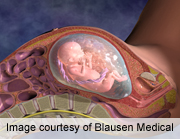
Connections in the Developing Brains of 3rd Trimester Babies

Scientists found the order and strength of brain connections in developing fetuses. This information may be used to understand how brain connections can go wrong leading to disorders such as dyslexia, ADHD, and autism.

Using real-time images of brain connections developing in late-stage fetuses, scientists say they've been able for the first time to compare the order and strength of these connections.
The research, though very preliminary, might one day lead the way to more effective therapies for brain disorders such as dyslexia, attention-deficit/hyperactivity disorder (ADHD) and autism, the researchers said.
Scientists from the U.S. National Institute of Child Health and Human Development and Wayne State University School of Medicine looked at 25 fetal brains from a group of pregnant women between 24 and 38 weeks of gestation. The researchers used an imaging technique called functional MRI (fMRI) to visualize "communication" between various regions of the brain.
The scientists learned that connections between the right and left sides of the brains got stronger as fetuses grew older. They said they also learned that shorter distances between matching areas produced stronger signals than longer spans between corresponding areas on the brain's outer edges.
"What we're seeing is a picture of emerging connectivity . . . that the right and left side are kind of building a bridge to each other," said study author Moriah Thomason, an assistant professor of pediatrics at Wayne State, in Detroit. "It's evidence for the fact that already in fetal life, this anatomy is being constructed in a way that we would expect. But for the first time, we can show the development of these networks."
The findings are published in the Feb. 20 issue of the journal Science Translational Medicine.
While scientists had previously used fMRI scans on fetuses, this new research is the first to compare a group of fetuses and identify features of development, Thomason said. Nearly 90 percent of the pregnant mothers participating in the study were black, while the rest were white or multiracial. They later delivered 17 boys and eight girls.
MRI scans don't emit radiation, thus minimizing risk to the fetuses during the procedure. The technique showed significant connections between half of the dozens of brain areas tested.
The findings might provide groundwork for understanding how and when brain development may go awry during gestation, Thomason said. This may possibly lead to better understanding of conditions such as ADHD, dyslexia and autism, which are thought to arise from disrupted brain networks, she said.
"If we know what gets in the way of those [normal] processes, we have a better shot at treating those disorders," Thomason said. "It's not just about early identification. An additional valuable outcome is, when you can see what normal looks like and see what disruption looks like, you have the opportunity to pick out patterns that tell you about the origin of that disease," she explained.
"The brain can be a tattletale to what is going on in those diseases," Thomason added, "and that can help us develop novel treatments."
Read more here

Sunday, December 11, 2011

Pollution plays a role in autism and dyslexia, say Israeli and foreign scientists


Conclusions emerge from presentations by Israeli and foreign scientists at a conference on the relationship between pollution and children's health problems.

Growing evidence suggests pollution plays a significant role in developmental problems among children, including autism, attention deficit disorder and even dyslexia, it was revealed at a conference on the subject in Israel Wednesday.

These conclusions emerged from presentations by Israeli and foreign scientists at a conference on the relationship between pollution and children's health problems. The conference, sponsored by the Environment and Health Fund, was part of the annual convention of the Israel Ambulatory Pediatric Association.

One of the principal speakers at the conference was Prof. Philip Landrigan, a pediatrician at Mount Sinai Hospital in New York, who noted that many countries worldwide have reported a sharp rise in recent years in the prevalence of development disorders such as autism and ADD. This rise cannot be attributed solely to genetic factors or to higher rates of diagnosis, he said, and today, even researchers who once thought environmental factors could explain only a small fraction of the increased incidence of autism, for instance, have been convinced that it accounts for at least 25 percent of the rise.

Exposure to substances such as lead, mercury and pesticides is particularly dangerous for children, because they are more sensitive to these materials - in part because their brains are still developing, Landrigan said. A child's body also breaks down poisonous materials less efficiently than the adult body does, and any given quantity of chemical has more of an impact on a child because it constitutes a larger proportion of his body mass. Additionally, most children will spend more years being exposed to poisonous substances than adults will, he said.

Today, blood tests find hundreds of types of chemicals in children's blood, Landrigan noted. But little is known about the effects of most of these substances because they have never been studied. And while hundreds of other substances have been identified as harmful to human health, their impact on children in particular has generally not been investigated. Nor has research been done on the cumulative effect of exposure to multiple poisonous substances - though modern humanity makes use of some 80,000 different chemicals, he said.

Some Western countries have tried to contend with the problem by requiring chemical manufacturers to do more testing of and reporting on their products' health impact, but so far success has been partial.

Dr. Orna Metzner of the Environmental Protection Ministry said that Israel, too, is now working on creating a database for chemical safety data, as one of the commitments it undertook when it joined the OECD.

One of the successes of recent years has been in reducing children's exposure to lead. Dr. Tamar Berman, the Health Ministry's toxicologist, said the level of lead found in drinking water now exceeds the permitted maximum in only two percent of samples - though she stressed that, given the risks of lead exposure, this is still too much.

Read more: http://www.haaretz.com/print-edition/news/pollution-plays-a-role-in-autism-and-dyslexia-say-israeli-and-foreign-scientists-1.398829