Showing posts with label brain shrinking. Show all posts

Thursday, January 08, 2015

Interesting facts about sleep

This article discusses a few interesting facts about sleep.

A proper sleep cycle ensures the well-being of our physical and mental health, but surprisingly we do very little to maintain our sleep cycle. These intriguing facts about sleep will motivate, if not coerce, you to take your 'sleep' more seriously.

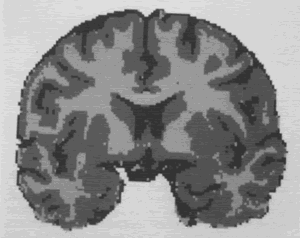
· Economizing on sleep may lead to shrinking of brain
It's a fact that human brain does shrink with age, but people who sleep for less duration are prone to increased rate of reduction. The fact is backed by a research. There are many factors like cholesterol levels, physical activity which are linked to the rate of change in brain volume over a period of time—and sleep has emerged as one of the important factors. A study carried out by Claire Sexton, DPhil, lead researcher found that people who sleep less clocked a higher rate of decline in the size of the frontal, temporal, and parietal lobe areas of the brain.

· Less sleep may lead to or speed up Dementia 
Researchers and doctors promote sleep for an enhanced memory. Now studies have found out that less sleep may lead to dementia or accelerate the emergence of this disease. More research is needed to establish if lack of sleep actually causes dementia; till then, the best thing to do is to relax and sleep for sufficient number of hours.

· Brain makes decision while we are asleep
Remember those times when you were irked to make a decision but couldn't make it. You closed your work and went to sleep. And when you woke up you realized that you've made the decision. Ever wondered why and how? This is a result of your brain that was busy organizing information, processing data and clearing up unnecessary information while you were asleep. The fact was brought to light in a study that was done by a team of French and UK researchers. In this research, a group of adults were given a task of word classification, one when they were awake, and the other while they were asleep. The researchers found that same pattern of brain activities were happening when individuals were presented with even more words while they were asleep. This perfectly explains why we respond when someone calls out our name while we are asleep.

· Sleep Apnea can be treated better with the help of family
Sleep apnea is a sleep disorder which is characterized by breathing pauses or breaks during sleep. There are two types of sleep apnea: obstructive sleep apnea and central sleep apnea. The problem can be mild or severe, based on how often your lungs don't get enough air. Continuous positive airway pressure (CPAP) is the best method for treating sleep disorders. Family support is vital to make a person adhere to this treatment. Studies suggest, people who rated their family relationship quality higher, adhered to CPAP treatment more closely.

· Night birds have more difficulty sticking to an exercise routine
Early risers are found to be disciplined when it comes to exercise routine. It is quite easy for them to get out of bed early morning, and go out for jogging, running, or other exercises. While on the other hand, night owls find it troublesome to stick to an exercise routine. For them getting out of bed early morning is next to impossible. In a study, it was found that night owls generally spent their time sitting aimlessly, feel like doing nothing and gave excuses for not being able to exercise like insufficient number of hours in the day.

· Sleeping with a pet alongside messes your sleep
The world is filled with pet lovers. Out of these pet lovers some even go to an extent where they share bed with their pets. This may sound wonderful but it actually affects your sleep. A research presented at the annual meeting of the Associated Professional Sleep Societies, found that 30% of pet owners who shared bed with their pets get interrupted sleep as they had to get up at least once in the night due to the barks, meows, tail wags, and more. So, overall this idea of sharing bed, however cute it sounds, will disrupt your sleep and affect your health.

Read more here

Monday, September 08, 2014

Not enough sleep can cause the brain to shrink

A study shows that not getting enough sleep can cause a brain's gray matter to shrink.

Not getting a good night's sleep might be linked to shrinkage of the brain's gray matter over time, new research suggests.
Faster deterioration of three parts of the brain was seen in mostly older adults who had poor sleep quality, though not necessarily too little sleep. Sleep difficulties included having trouble falling asleep, waking up during the night or waking up too early.
However, it isn't clear whether poor sleep causes the changes in the brain, whether a shrinking brain causes poor sleep, or whether a bit of both is occurring.
"We spend roughly a third of our lives asleep, and sleep has been proposed to be 'the brain's housekeeper,' serving to restore and repair the brain," said lead researcher Claire Sexton, a postdoctoral research assistant at the University of Oxford in England.
"It follows that if sleep is disrupted, then processes that help restore and repair the brain are interrupted and may be less effective, leading to greater rates of decline in brain volume," she explained.
But it's just as likely, she said, that the deterioration in the brain also contributes to difficulty sleeping.
"It may be that greater rates of decline in brain volumes make it more difficult for a person to get a good night's sleep," said Sexton, adding she suspects the problems run in both directions.
While a visiting research fellow at the University of Oslo, Norway, Sexton and her fellow researchers gave brain scans to 147 Norwegian adults, average age 54, at the study's start and an average of 3.5 years later.
At the time of the second scan, the adults also filled out questionnaires about their sleep quality, including how long and how well they slept, how long it took to fall asleep, how much time in bed was spent actually asleep, how often they woke up, how sleepy they were during the day and whether they used sleeping medications. Participants took an average of 20 minutes to fall asleep and slept an average of seven hours a night, the researchers found.
After making adjustments for differences in the participants' physical activityweight and blood pressure -- which have been shown to affect sleep quality -- the researchers compared changes in participants' brain scans and reported their findings online Sept. 3 in Neurology.
In those with poor sleep quality, the researchers saw shrinkage in one part of their frontal cortex and some atrophy, or deterioration, throughout three other parts of the brain, including parts involved with reasoning, planning, memory and problem-solving.
The study didn't test participants' thinking skills, so it couldn't prove that poor sleep or brain shrinkage was linked to poor memory or difficulty thinking. However, past research has found links between declining memory and decreases in brain volume.
"We often correlate brain shrinkage with losing brain tissue, and assume that that isn't advantageous as you get older," said Anton Porsteinsson, director of Alzheimer's disease care, research and education at the University of Rochester School of Medicine and Dentistry in New York.
"Sleep disturbance is such a common symptom among the general population, and it often becomes worse as you age," he said. "There is growing data to suggest that sleep disturbance may be a risk factor for poor outcomes in terms of brain cells and other medical issues as well."
The correlation was only with poor quality of sleep, not shorter sleep. The reduced brain size in poor sleepers was seen across all ages, but the correlation was stronger among adults over 60, the study found.
"What this study signals to me is that [good bedtime habits] and good sleep matters," Porsteinsson said. "Whether that has to be natural sleep or whether we can use medications to enhance sleep has not been answered, but it's probably best to improve your natural sleep patterns."
Sexton made several suggestions for those hoping for better sleep. Besides talking to a doctor about sleep problems, she recommended having a bedtime routine and going to bed at the same time each night.
Other tips include removing gadgets such as smartphones and tablets from the bedroom, not checking emails right before sleep, being physically active during the day, avoiding caffeine late in the day and spending time outside in the sunlight each day.
Read more here