Showing posts with label how do i improve memory. Show all posts

Tuesday, August 25, 2015

Study: Sleep makes memories more accessible

A study shows that sleep makes memories more accessible.

Sleeping not only protects memories from being forgotten, it also makes them easier to access, according to new research from the University of Exeter and the Basque Centre for Cognition, Brain and Language. The findings suggest that after sleep we are more likely to recall facts which we could not remember while still awake.
In two situations where subjects forgot information over the course of 12 hours of wakefulness, a night's sleep was shown to promote access to memory traces that had initially been too weak to be retrieved.
The research, published in the journal Cortex, tracked memories for novel, made-up words learnt either prior to a night's sleep, or an equivalent period of wakefulness. Subjects were asked to recall words immediately after exposure, and then again after the period of sleep or wakefulness.
The key distinction was between those word memories which participants could remember at both the immediate test and the 12-hour retest, and those not remembered at test, but eventually remembered at retest.
The researcher found that, compared to daytime wakefulness, sleep helped rescue unrecalled memories more than it prevented memory loss.
Nicolas Dumay of the University of Exeter explains: "Sleep almost doubles our chances of remembering previously unrecalled material. The post-sleep boost in memory accessibility may indicate that some memories are sharpened overnight. This supports the notion that, while asleep, we actively rehearse information flagged as important. More research is needed into the functional significance of this rehearsal and whether, for instance, it allows memories to be accessible in a wider range of contexts, hence making them more useful."
The beneficial impact of sleep on memory is well established, and the act of sleeping is known to help us remember the things that we did, or heard, the previous day. The idea that memories could also be sharpened and made more vivid and accessible overnight, however, is yet to be fully explored.
Dr Dumay believes the memory boost comes from the hippocampus, an inner structure of the temporal lobe, unzipping recently encoded episodes and replaying them to regions of the brain originally involved in their capture -- this would lead the subject to effectively re-experience the major events of the day.
Nicolas Dumay is an experimental psychologist at the University of Exeter and an honorary Staff Scientist at the Basque Centre for Cognition, Brain and Language (BCBL), in Spain.
'Sleep not just protects memories against forgetting, it also makes them more accessible' is published in the journal Cortex.
Read more here

Friday, November 22, 2013

Study: Exercise improves brain activity and memory in adults

A study claims that aerobic exercise has many benefits for adults including improved brain activity and memory in addition to physical fitness.

A new study conducted by researchers at the Center for BrainHealth at The University of Texas at Dallas published online in the open-access journal Frontiers in Aging Neuroscience found that engaging in a physical exercise regimen helps healthy aging adults improve their memory, brain health and physical fitness. This finding is significant considering that among adults 50 and older, "staying mentally sharp" outranks social security and physical health as the top priority and concern in the United States.
"Science has shown that aging decreases mental efficiency and memory decline is the number one cognitive complaint of older adults," said Sandra Bond Chapman, Ph.D., founder and chief director of the Center for BrainHealth, Dee Wyly Distinguished University Chair and lead author of the paper. "This research shows the tremendous benefit of aerobic exercise on a person's memory and demonstrates that aerobic exercise can reduce both the biological and cognitive consequences of aging."
For the study, sedentary adults ages 57-75 were randomized into a physical training or a wait-list control group. The physical training group participated in supervised aerobic exercise on a stationary bike or treadmill for one hour, three times a week for 12 weeks. Participants' cognition, resting cerebral blood flow, and cardiovascular fitness were assessed at three time points: before beginning the physical exercise regimen, mid-way through at 6 weeks, and post-training at 12 weeks.
"By measuring brain blood flow non-invasively using arterial spin labeling (ASL) MRI, we can now begin to detect brain changes much earlier than before," said Sina Aslan, Ph.D., founder and president of Advance MRI and collaborator on the study. "One key region where we saw increase in brain blood flow was the anterior cingulate, indicating higher neuronal activity and metabolic rate. The anterior cingulate has been linked to superior cognition in late life."
Exercisers who improved their memory performance also showed greater increase in brain blood flow to the hippocampus, the key brain region affected by Alzheimer's disease. Chapman pointed out that, using noninvasive brain imaging techniques, brain changes were identified earlier than memory improvements, implicating brain blood flow as a promising and sensitive metric of brain health gains across treatment regimens.
"Physical exercise may be one of the most beneficial and cost-effective therapies widely available to everyone to elevate memory performance," Chapman said. "These findings should motivate adults of all ages to start exercising aerobically."
Chapman cautioned that while physical exercise is associated with a selective or regional brain blood flow, it did not produce a change in global brain blood flow.
"In another recent study, we have shown that complex mental training increases whole brain blood flow as well as regional brain blood flow across key brain networks," Chapman said. "The combination of physical and mental exercise may be the best health measures to improve overall cognitive brain health. We have just begun to test the upper boundaries of how we can enhance our brain's performance into late life. To think we can alter and improve the basic structure of the mature brain through aerobic exercise and complex thinking should inspire us to challenge our thinking and get moving at any age."
Read more here

Wednesday, July 24, 2013

Vitamin D deficiency linked with cognitive impairment in adults

This study shows that Vitamin D deficiency, or hypovitaminosis D, is linked with cognitive impairment in adults affecting their memory.

Hypovitaminosis D is associated with global cognitive impairment in adults. It remains unclear which domain–specific cognitive functions are affected with hypovitaminosis D. Lower serum 25OHD concentrations predict executive dysfunctions, especially on mental shifting, information updating and processing speed. The association with episodic memory remains uncertain.

Abstract

Background: Hypovitaminosis D is associated with global cognitive impairment in adults. It remains unclear which domain-specific cognitive functions are affected with hypovitaminosis D. Objective. To systematically review and quantitatively synthesize the association of serum 25-hydroxyvitamin D (25OHD) concentrations with episodic memory and executive functions in adults. Methods: A Medline and PsycINFO®libraries search was conducted on May 2012, with no limit of date, using the Medical Subject Headings (MeSH) terms “Vitamin D” OR “Hydroxycholecalciferols” combined with the MeSH terms “Memory” OR “Memory Disorders” OR “Executive Function” OR “Attention” OR “Cognition” OR “Cognition disorders” OR “Dementia” OR “Alzheimer disease” OR “Neuropsychological Tests”. Fixed-effects meta-analysis was performed from 12 eligible studies using an inverse-variance method. Results: Of the 285 selected studies, 14 observational studies (including 3 prospective cohort studies) and 3 interventional studies met the selection criteria. All were of good quality. The number of participants ranged from 44–5,692 community-dwellers (0–100% women). In the pooled analysis, although episodic memory disorders showed only modest association with lower 25OHD concentrations (summary effect size of the difference (ES) = −0.09 [95%CI:−0.16;−0.03]), associations of greater magnitude were found with executive dysfunctions (processing speed: mean difference of Trail Making Test (TMT)-A score = 4.0 [95%CI:1.20;6.83]; mental shifting: mean difference of TMT-B score = 12.47 [95%CI:6.78;18.16]; information updating tests: ES = −0.31 [95%CI:−0.5;−0.09]). The pooled risk of incident decline of TMT-B score was OR = 1.25 [95%CI:1.05;1.48] in case of initial lower 25OHD concentrations. Vitamin D repletion resulted in improved executive functions (ES = −0.50 [95%CI:−0.69;−0.32] for before-and-after comparison), but exhibited no difference with control groups (ES = 0.14 [95%CI:−0.04;0.32] for between-group comparison after intervention). Conclusion: Lower serum 25OHD concentrations predict executive dysfunctions, especially on mental shifting, information updating and processing speed. The association with episodic memory remains uncertain.
Methods
  • A Medline and PsycINFO libraries search was conducted on May 2012, with no limit of date, using the Medical Subject Headings (MeSH) terms “Vitamin D” OR “Hydroxycholecalciferols” combined with the MeSH terms “Memory” OR “Memory Disorders” OR “Executive Function” OR “Attention” OR “Cognition” OR “Cognition disorders” OR “Dementia” OR “Alzheimer disease” OR “Neuropsychological Tests”.
  • Fixed–effects meta–analysis was performed from 12 eligible studies using an inverse–variance method.
Results
  • Of the 285 selected studies, 14 observational studies (including 3 prospective cohort studies) and 3 interventional studies met the selection criteria.
  • All were of good quality. The number of participants ranged from 44–5,692 community–dwellers (0–100% women).
  • In the pooled analysis, although episodic memory disorders showed only modest association with lower 25OHD concentrations (summary effect size of the difference (ES) = –0.09), associations of greater magnitude were found with executive dysfunctions (processing speed: mean difference of Trail Making Test (TMT)–A score = 4.0 [95%CI:1.20;6.83]; mental shifting: mean difference of TMT–B score = 12.47 [95%CI:6.78;18.16]; information updating tests: ES = –0.31).
  • The pooled risk of incident decline of TMT–B score was OR = 1.25 [95%CI:1.05;1.48] in case of initial lower 25OHD concentrations.
  • Vitamin D repletion resulted in improved executive functions, but exhibited no difference with control groups (ES = 0.14 [95%CI:–0.04;0.32] for between–group comparison after intervention).
Read more here

Saturday, January 26, 2013

Sleep Apnea May Damage Brain Cells Associated With Memory


"How do I motivate my spouse to see a doctor?" I was asked this question yesterday and I could offer some facts. But, a picture really goes a long way. JR


Sleep Apnea May Damage Brain Cells Associated With Memory

June 11, 2008
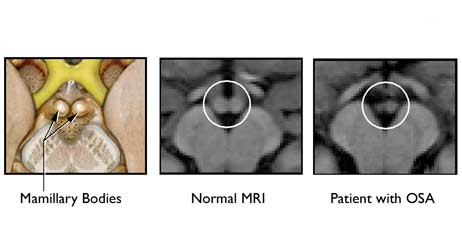
June 11, 2008 — People with obstructive sleep apnea (OSA), a common sleep disorder linked to heavy snoring, may lose tissue in brain regions that store short-term memories—the type used to recall a recent joke or recognize a person you met at a party—say researchers at the University of California at Los Angeles.
brain memory mri 462 Sleep Apnea May Damage Brain Cells Associated With MemoryDaytime confusion and memory loss are known symptoms of sleep apnea; people with the condition often rouse hundreds of times a night (without fully waking) and are tired and forgetful the next day. But a study in the June 27, 2008, edition of the journalNeuroscience Letters suggests that there may be more to it than just that.
Why sleep apnea may affect memory
Memories are formed in the mammillary bodies, structures on the underside of the brain that resemble small breasts. When UCLA neuroscientists scanned the brains of 43 sleep apnea patients and 66 healthy volunteers using magnetic resonance imaging (MRI), they discovered that the sleep apnea patients’ mammillary bodies were nearly 20% smaller than those of the untroubled sleepers.Mammillary bodies
brain memory area 180 Sleep Apnea May Damage Brain Cells Associated With MemoryRead more here