Showing posts with label childrens sleep specialist Texas. Show all posts

Saturday, January 26, 2013

Sleep Apnea May Damage Brain Cells Associated With Memory


"How do I motivate my spouse to see a doctor?" I was asked this question yesterday and I could offer some facts. But, a picture really goes a long way. JR


Sleep Apnea May Damage Brain Cells Associated With Memory

June 11, 2008
June 11, 2008 — People with obstructive sleep apnea (OSA), a common sleep disorder linked to heavy snoring, may lose tissue in brain regions that store short-term memories—the type used to recall a recent joke or recognize a person you met at a party—say researchers at the University of California at Los Angeles.
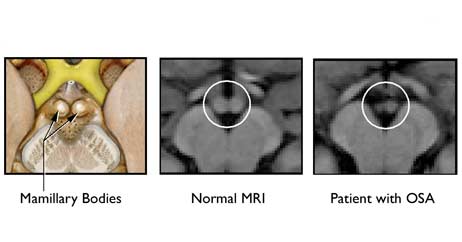
brain memory mri 462 Sleep Apnea May Damage Brain Cells Associated With MemoryDaytime confusion and memory loss are known symptoms of sleep apnea; people with the condition often rouse hundreds of times a night (without fully waking) and are tired and forgetful the next day. But a study in the June 27, 2008, edition of the journalNeuroscience Letters suggests that there may be more to it than just that.
Why sleep apnea may affect memory
Memories are formed in the mammillary bodies, structures on the underside of the brain that resemble small breasts. When UCLA neuroscientists scanned the brains of 43 sleep apnea patients and 66 healthy volunteers using magnetic resonance imaging (MRI), they discovered that the sleep apnea patients’ mammillary bodies were nearly 20% smaller than those of the untroubled sleepers.Mammillary bodies
brain memory area 180 Sleep Apnea May Damage Brain Cells Associated With MemoryRead more here

Thursday, November 22, 2012

How do you treat sleep apnea in children? Can medicine help?


What medicines may treat sleep apnea in children? Following a sleep study diagnosing sleep apnea,  This article shows that a commonly prescribed medicine for allergies might help to treat sleep apnea. - JR


 2012 Sep;130(3):e575-80. doi: 10.1542/peds.2012-0310. Epub 2012 Aug 6.

Montelukast for children with obstructive sleep apnea: a double-blind, placebo-controlled study.

Source

Department of Pediatrics, Soroka University Medical Center, Faculty of Health Sciences, Ben-Gurion University, POB 151, Beer Sheva, Israel. avivgold@bgu.ac.il

Abstract

OBJECTIVES:

Children with nonsevere obstructive sleep apnea (OSA) benefit from alternative therapeutic interventions such as leukotriene modifiers. We hypothesized that montelukast might improve OSA in children. We tested this hypothesis in a double-blind, randomized, placebo-controlled fashion.

METHODS:

Of 50 possible candidates, we recruited 46 children with polysomnographically diagnosed OSA. In this prospective, double-blind, randomized trial, children received daily oral montelukast at 4 or 5 mg (<6 or="or">6 years of age, respectively) or placebo for 12 weeks. Polysomnographic assessments, parent questionnaires, and radiographs to assess adenoid size were performed before and after therapy.

RESULTS:

Compared with the 23 children that received placebo, the 23 children that received montelukast showed significant improvements in polysomnographic measures of respiratory disturbance (obstructive apnea index), children's symptoms, and adenoid size. The obstructive apnea index decreased by >50% in 65.2% of treated children. No attrition or side effects occurred.

CONCLUSIONS:

A 12-week treatment with daily, oral montelukast effectively reduced the severity of OSA and the magnitude of the underlying adenoidal hypertrophy in children with nonsevere OSA.