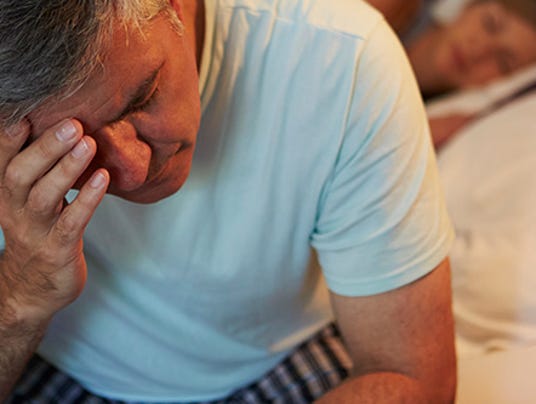
When you know that "apnea" is the Greek word for "without breath," you begin to understand how scary sleep apnea can be. Sleeping without breath? That just can't be good for you … and it's not. Because its main symptoms (snoring and daytime fatigue) are easily overlooked, it is one of the most undiagnosed sleep disorders in the country, according to Health Magazine.
Sleep apnea has been shown to be related to a host of health concerns, including hypertension and heart disease, but when it comes to the relationship between sleep apnea and weight gain, which comes first? Does weight gain cause sleep apnea, or does sleep apnea cause weight gain?
In one of those great anatomical double-whammies, the answer to that question is "yes" and "yes." The National Heart, Lung, and Blood Institute explains that sleep apnea happens when you're asleep and your upper respiratory passages relax. For most of us, that's no big deal. For some people, though, that can cause problems. It may be because their airways are more narrow, their tongues are too big, or their tonsils are too large. And it may be because they are overweight. If you're carrying extra soft fat tissue, it can actually thicken the walls of your windpipe, making it narrower and increasing your risk for sleep apnea. So yes, gaining weight can contribute to getting sleep apnea.
But it doesn't stop there. Because sleep apnea means that you never (and I mean, never) get a good night's sleep, the idea of any exercise seems absurd. It would be like having a newborn baby that doesn't ever grow up. Actually, it would be worse than that because even newborns will let you sleep for a couple of hours at a time. Sleep apnea doesn't. You can wake up gasping for breath every few minutes all night long, or you can just snort and snore and roll over many times in the course of sleep cycle. Either way, you don't ever run a full sleep cycle; your body never really gets the rest it needs to rebuild or rejuvenate. You are exhausted all the time. You know you need to exercise to lose some weight so you can sleep better, but you're out of breath just walking to your car; how in the world are you going to walk around the block or take the stairs instead of the elevator?
And just to add insult to injury, a 2004 PLOS study revealed that sleep-deprived people had higher levels of ghrelin, the hormone our body produces to stimulate appetite, and reduced levels of leptin, the hormone our bodies make to suppress appetite. So, yes, sleep apnea can contribute to gaining weight.
So what's an overweight, sleep-deprived person to do? Don't despair; there are options. Traditional sleep apnea treatments such as CPACs (continuous positive airway compressors) can be helpful. Some people learn to sleep with them all night, every night. Others can never really get quite comfortable with it, but it might be just enough to get them moving in the right direction. Even just walking to the end of the street helps, and many sleep apnea patients enjoy bike riding because it lessens the pressure on their joints. The key is to tackle both issues – weight gain and sleep apnea – together, as improvements in one condition often yield improvements in the other. Just as the two worsen together, so they also improve together. Small changes can make a big impact over time, so the important thing is to talk to you doctor, don't give up, and take it one small step at a time.
If you feel like you never get a good night's sleep, sleep apnea could be to blame. Ask your doctor for more information, and remember that St. Francis offers a Sleep Disorder Center that can help identify the source of your sleeplessness.
Read more here

