Showing posts with label success. Show all posts

Monday, October 06, 2014

Children with ADHD perform worse than peers in second grade

A study shows that children with ADHD perform below their peers as early as second grade.

Children with attention-deficit/hyperactivity disorder (ADHD) perform well below their peers who do not have ADHD on multiple functional domains as early as grade 2, a new community-based study shows.
Daryl Efron, MD, Murdoch Children's Research Institute, Melbourne, Australia, and colleagues found that children with ADHD between 6 and 8 years of age were 11.0 times more likely to meet criteria for externalizing disorders than non-ADHD control children (P < .001).
They were also almost 3 times more likely than control individuals to meet criteria for internalizing disorders (P = .02).
On both reading and math computation, "striking" differences in academic performance were again observed between children who had ADHD and control children, equating to nearly a full standard deviation for both literacy and numeracy, the researchers report.
Children with ADHD were also more likely than control children to have problems with their peers according to both parent and teacher reports.
Yet prior to study enrollment, only 17% of children in the ADHD group had been diagnosed with ADHD, and only 13% were taking a medication for it.
"In their second year of school, children who had ADHD performed worse than controls across all functional domains, yet only a minority had been formally diagnosed with ADHD," investigators write.
"Findings highlight the need for earlier diagnosis and intervention."
The study was published online September 29 in Pediatrics.
High Comorbidity Burden
Participants were recruited from 43 elementary schools in metropolitan Melbourne, Australia.
The Conners 3 ADHD Index was distributed to parents of all second grade children in participating schools. Teachers completed the same measure.
Children were defined as screening negative for ADHD if their score on the ADHD Index was less than the 75th percentile (boys) or less than the 80th percentile (girls) by both parent and teacher reports and there was no parent-reported diagnosis of ADHD.
Each positive screen was randomly matched on sex and school to a negative screen.
ADHD Index cases were confirmed, and the presence of mental health comorbidities was assessed using the National Institute of Mental Health's Diagnostic Interview Schedule for Children, Version IV, conducted face-to-face with parents.
Children were classified as having an internalizing disorder if they met criteria for separation anxiety disorder; social phobia; generalized anxiety disorder; posttraumatic stress disorder; obsessive-compulsive disorder; hypomania; or manic episode.
Children were classified as having an externalizing disorder if they met criteria for oppositional defiant disorder or conduct disorder.
Academic achievement was assessed using the word reading and math computation subtests of the Wide Range Achievement Test 4, and social functioning was assessed by using the 5-item parent- and teacher-reported peer problems scale of the Strengths and Difficulties Questionnaire.
A total of 179 children with ADHD and 212 children without were compared across the various functional domains. Among those with ADHD, 93 had the combined ADHD subtype; 64, the inattentive subtype; and 22, the hyperactive subtype.
The most prevalent comorbid mental health disorder in children with ADHD was oppositional defiant disorder, affecting 54.2% of the group.
Children with ADHD were also significantly more likely than control children to have multiple impairments (P < .001).
The authors note that only 11% of children with ADHD had no functional impairments, compared with 57% of non-ADHD control children.
Children with ADHD "had a high burden of mental health comorbidities, were performing markedly worse academically, and had poorer peer relations," the investigators write.
"Our findings suggest that comorbidities are identifiable by early primary school age if symptoms are inquired about systematically."
"This is important," they add, "as children who have ADHD and comorbidities respond optimally to a combination of medication and behavioral interventions."
Read more here

Sunday, August 25, 2013

Sleep and academic success in children

This article discusses how important sleep is to academic success for young children.

CHILDREN who have trouble sleeping tend to do worse in school than their peers who get a good night’s sleep, a new study suggests.
Researchers in Brazil looked at children aged seven to 10 who attended São Paulo public schools. They found children with symptoms of sleep disorders or sleep breathing disorders earned lower grades than those without problems sleeping, on average.
Thirteen percent of children with difficulty sleeping had failing grades in Portuguese, compared with 9% of those without sleep problems. Likewise, 25% of children with disrupted sleep had failing maths grades, versus 8% of children without trouble sleeping.
"Because (symptoms of sleep disorders) and particularly (sleep breathing disorders) are highly prevalent, we suggest that all health professionals and educators become aware of this striking effect and take appropriate actions to solve or mitigate what could very well constitute a public health issue," researchers led by Dr Luciane Bizari Coin de Carvalho from the Universidade Federal de São Paulo write.
In the US, experts estimate that roughly a quarter of children have disrupted sleep at some point during childhood. There are no definitive statistics on how many South African children have disrupted sleep patterns, but experts say rates are likely to be as high, if not slightly higher in this country, for a variety of socioeconomic reasons.
Erratic bedtime hours and anxiety, either at school or at home, may contribute.
Sleep disorders
Other children may have unrecognised sleep disorders, such as sleep walking, nightmares or insomnia, or sleep breathing disorders such as sleep apnea. Some medications, including those for asthma or attention-deficit/hyperactivity disorder, can affect sleep. The underlying medical problems may also cause sleep disturbances.
Poor sleep among children has been tied to obesity, which over the long term increases the risk of heart disease and diabetes. And poor school performance has been linked to early dropout rates, so the new findings may have implications beyond getting a good night’s sleep, researchers say.
From 1999 to 2001, the researchers distributed 5,400 questionnaires asking about symptoms of sleep disorders and sleep breathing disorders to children in São Paulo public schools.
Then they looked at the Portuguese and maths grades of 2,384 children whose parents filled out and returned the questionnaire.
The study team found about 31% of the children had symptoms of sleep disorders — such as difficulty falling or staying asleep, or feeling sleepy all the time — and close to 27% had sleep breathing disorders. Those students’ grades were significantly lower than the grades of children without sleep disorder symptoms.
In Brazil, grades are based on a scale of 0 to 10, with 5 considered passing. Average Portuguese grades were 6.6 for children with sleep problems, compared with 7.1 among those with no sleeping trouble.
Likewise, children with symptoms of sleep disorders or sleep breathing disorders earned an average grade of 6.3 in maths, compared with 7.1 for other children, according to findings published in the journal Sleep Medicine.
Dr Carl Bazil, a neurologist and director of the division of epilepsy and sleep at New York-Presbyterian/Columbia University Medical Centre in New York City, notes that this study fills a research void.
Learning information
"There’s growing information, mainly in adults, that you need good quality sleep to process and learn new information," Dr Bazil says.
"It stands to reason that, if anything, sleep would be more important in children, but there’s very little information in children about sleep disturbance and learning."
Research has shown that sleep deprivation might affect certain parts of the brain, especially the frontal lobes. The frontal lobes control executive function, which is the ability to make decisions, form memories, plan for the future and inhibit socially undesirable behaviour, such as fighting with a classmate.
However, the new study cannot say definitively that sleep problems were to blame for poor grades, researchers say.
"This study doesn’t prove that a sleep disturbance causes decreased academic performance," Dr Bazil says, "but it shows an association. Basically every category of sleep disturbance the authors looked at correlated with decreased academic performance."
The researchers relied on parents’ reports of their children’s sleep, rather than bringing children into a sleep lab overnight, for example.
The study is "far from perfect", Dr Bazil says. But, "it’s a first step in emphasising that sleep in children is something that’s important, not only to prevent them from being sleepy but to make sure that they learn.
"I think this study will help raise awareness that sleep is particularly important in children."
Read more here

Wednesday, August 21, 2013

Healthy diet and sleep help children learn

For children, success at school is influenced by a healthy diet and getting enough sleep.

Backing what many parents already believe, experts say that healthy eating and good sleep habits can help youngsters do well at school.
"Your brain can't work if you're not consuming enough calories, and in general that's not a problem," Krista Casazza, an assistant professor in the nutrition sciences department at the University of Alabama at Birmingham, said in a university news release. "But when kids go to school without eating breakfast, their [thinking and learning skills] can be affected."
Children should start the day with fruits, proteins and whole grains. They should avoid sugary cereals because they cause a sugar high followed by a crash.
"A balanced breakfast will fuel the body for a long period and help sustain their attention level through lunch, when they need to eat well again," Casazza said. "This will hold them until dinner, and they won't snack ravenously after school."
If their kids do need to eat something before dinner, parents can offer healthy choices such as yogurt, fruits and vegetables. Baked chips, in moderation, can be an option if children want "kid stuff." For a drink, give them water instead of soda.
Sleep is another important part of success at school.
"Children need a good night's sleep for their overall school performance," Kristin Avis, an associate professor in the pulmonary and sleep medicine division in the pediatrics department at UAB, said in the news release.
"Lack of sleep can lead to problems with attention and memory in the classroom, affect impulse control and mood regulation [and] lead to anxiety and even depression," she explained.
Children aged 6 to 12 should get nine hours sleep per night, as should teens aged 13 to 18. However, they typically average little more than seven hours per night, Avis said.
"Often parents think one night of sleep loss won't matter, but that's all it takes to affect them the next day," she said. "If they are chronically deprived, it can snowball and make matters worse."
Trying to catch up on lost sleep on the weekend can compound the problem.
"If kids sleep in Saturday, they have a hard time going to bed Saturday night; so they sleep in Sunday and have a hard time going to bed Sunday night. Monday morning they are tired, and it's hard to wake up for school. They struggle to get back on a good sleep schedule," Avis said.
Children and teens need a consistent bedtime seven days a week.
"It keeps their clock set so they can go to bed at a certain time, sleep well through night and wake up well rested the next morning," Avis said.
Read more here

Monday, August 29, 2011

Radical brain surgery frees baby held captive by seizures


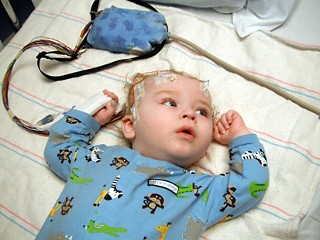
Evan Stauff smiles and giggles. He mimics his father in making silly noises. He loves to play with toys and watch cartoons.


The 19-month-old didn’t do any of those things before undergoing surgery this past winter to remove half of his brain, a procedure that’s called a “hemispherectomy.” His family noticed a change in his behavior almost immediately — starting with his ability to focus on family members, rather than look through them.


“It’s already a miracle,” said Evan’s grandmother, Karen Sands of Payette. “He’s a person now; he wasn’t before.”


Evan was diagnosed with infantile spasms when he was almost 3 months old. The spasms were the result of a specific kind of epilepsy that develops in young children.


They came in clusters, and his episodes lasted five to 15 minutes. Evan’s dad, 31-year-old David Stauff, believes he witnessed his baby go through thousands of spasms over a seven-month period before the surgery.


“His brain was always in a state of seizure,” said Kathleen Stauff, Evan’s mom. The baby was physically exhausted by the seizures and had a very erratic sleep pattern.


He was lethargic and catatonic — “trapped inside,” Sands said.


Before the surgery, Evan wasn’t able to sit up — or even able to hold his head up — and he couldn’t grab and hold toys. Now he’s able to sit and play on the floor of his grandparents’ Eagle home.

He’s still behind developmentally but is progressing.


“He’s doing really well. We couldn’t be any happier,” said his father, who quit his job at a credit union to care for the youngest of his three boys.


Read more: http://www.idahostatesman.com/2011/08/29/1776759/radical-brain-surgery-frees-baby.html#ixzz1WU25ydRX

Monday, February 14, 2011

Self-Control in Childhood Brings Adult Success
By Brenda Goodman

Jan. 24, 2011 -- Children who have good self-control early in life are more likely to grow into healthy, financially secure, and trouble-free adults than those with poor self-discipline, a new study shows.

The authors of the 32-year study, which has followed a group of almost 1,000 New Zealanders since birth, say the differences between kids who have good self-discipline and those who don't begin to be apparent in children as young as age 3.

Self-control appears to be so important that it may play an approximately equal role with other well-known influences on a person's life course, such as intelligence and social class.

More at the link.