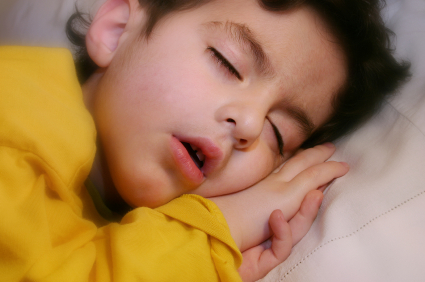
A study shows that weight gain in children can be triggered by tonsillectomies used to treat sleep apnea.
Tonsillectomies are commonly done to relieve sleep apnea in children, but a new study confirms that the treatment can speed kids' weight gain -- especially if they're already overweight.
The researchers said that's a concern, because obesity is a risk factor for a range of health problems -- including, ironically, sleep apnea. But they're not advising against tonsillectomy for kids who need it.
Instead, they said, doctors and parents should be aware that a healthy diet and exercise become even more important after children have the surgery.
"You can't just treat the sleep apnea. You have to have nutrition and lifestyle counseling, too," said lead researcher Dr. Eliot Katz, a respiratory disease specialist at Boston Children's Hospital.
A pediatric sleep specialist who was not involved in the study agreed.
"Nutrition and exercise are just as important as treating the sleep apnea with a single procedure," said Dr. Sangeeta Chakravorty, who co-directs the pediatric sleep evaluation center at Children's Hospital of Pittsburgh.
Obstructive sleep apnea arises when constriction in the airways causes repeated pauses in breathing during the night. In children, the most common cause is swelling in the tonsils and adenoids -- infection-fighting tissues in the back of the throat and the nasal cavity, respectively. And surgery to remove those tissues (known technically as adenotonsillectomy) is often recommended.
Doctors have long known that after the surgery, kids can gain weight at an accelerated clip, Chakravorty said.
But the new study, reported online July 28 and in the August print issue of the journal Pediatrics, offers "certainty" that it's actually an effect of the treatment, Katz said.
That's because children in the study were randomly assigned to have surgery or to "watchful waiting" -- putting off surgery and staying with other options, such as medications to better control any nasal allergies or asthma symptoms.
Altogether, 204 children aged 5 to 9 were assigned to have surgery right away, while 192 stuck with watchful waiting. Katz's team found that over seven months, children who underwent surgery showed a quicker average weight gain, versus kids in the comparison group.
It was a small difference overall, Chakravorty said. And for children who were normal weight, there was no major effect.
"It's not making normal-weight children obese," Chakravorty noted.
But there was a clearer impact on kids who were overweight before surgery. Of those children, 52 percent had become officially obese seven months after surgery, compared with 21 percent of overweight children in the watchful-waiting group, the study found.
There are a few possible explanations for the post-surgery weight gain, according to Katz's team. Calorie-burning may dip when children are no longer laboring to breathe during sleep. And some kids may burn fewer calories during the day because they become less active after their sleep apnea improves. (Paradoxically, poor sleep often causes children to be "hyperactive," rather than drowsy, Katz explained.)
Sleep apnea itself also causes metabolic changes, Katz said. Growth hormone is released at night, and the sleep disorder can interfere with that. So the body may adapt metabolism in an effort to maintain a child's growth.
"When the sleep apnea is relieved, they're set up for rapid weight gain," Katz said.
It was once common for children with sleep apnea to be underweight and have "failure to thrive," Chakravorty noted. For those kids, rapid weight gain after tonsillectomy can be a good thing.
But these days, with childhood obesity on the rise, many kids with sleep apnea are already overweight or obese. If they rapidly put on pounds, Katz said, their sleep apnea might return in six months to a year.
"After surgery, parents are often very satisfied," Katz noted. "Their kids are sleeping better, and they may be better behaved and doing better in school. But there's this insidious issue of weight gain."
Chakravorty agreed that diet and exercise are key for children with sleep apnea -- but she said that's true regardless of the treatment approach. And, for heavy kids, weight loss alone might clear up the sleep apnea.
But if children ultimately do need surgery, parents shouldn't skip it due to worries about weight gain, according to Katz. He noted that if improved sleep apnea symptoms explain the post-surgery pounds, then other treatments -- including medication or continuous positive airway pressure devices -- could also spur excess weight gain.
"I think there are implications beyond surgical treatment," Katz said.